



Student Blog
Classes
The Program is Flying By! ⟩
January 3, 2011, by Helen
Classes Getting Involved What are OS/OT?
It feels like just yesterday I was in the application process for the master’s program, anxious to learn Occupational Therapy and to one day become a therapist!
As 2010 just came to an end, I cannot believe that I only have six months left of the master’s program. In the last year and a half, it is amazing how much information we have covered. The first year flew by, providing us with a foundation of knowledge about pediatric OT, OT in the field of physical disabilities, geriatric OT, and OT in the fields of psychosocial/mental health. This second year, we have focused on learning how to build a therapeutic relationship with our clients, improving our listening skills, and understanding the theory behind our practice. By focusing on learning the history of where our profession has been, what the current state of our profession is, and where our profession is going, we are able to more creatively think about our own areas of interest. By better understanding what there is a need for in our profession, ideas of advocacy, research, and leadership are emphasized.
As a result of having learned so much about health care access, the history of our profession within the medical model, and the progression of current research, I have an increased interest in political advocacy and occupational therapy. Last year, I chose to get involved with an organization called CAHPSA (the California Health Professional Student Alliance). Currently, we are a week away from hosting Lobby Day in Sacramento. On January 9th and 10th, 200-500 health professional students will be traveling to Sacramento to meet with assembly members and senators to discuss how Health Care Reform will impact our personal professions.
One of my favorite aspects of our program has been the emphasis on understanding the theory behind our practice and the value for being aware of our professional past, present, and future. This value for the history of our profession is what has inspired me most to impact the future of occupational therapy practice.
⋯
Clinical Coursework ⟩
December 17, 2010, by Amanda
Classes What are OS/OT?
The path to becoming a clinician . . .
To continue delivering a picture of my experiences in studying occupational science and therapy at USC, I will introduce the clinical coursework. To pursue occupational therapy at some point we all decided that this was a career choice that fits our interests, academically and professionally. Before entering the program, I wondered, ‘how do you know what to do?’; when faced with a client with any number of strengths and limitations in occupational functioning, what is the first step? Furthermore, occupational therapists work with people on a whole continuum of diagnosis and conditions. How does occupational therapy school prepare the practitioner to work with both an individual referred for mental health services and an individual referred for a traumatic brain injury? As I previously explained in a blog post, the summer coursework lays the foundation for analyzing occupation. The first year is to start building your clinical skills. To be prepared to work in the physical disabilities, mental health, pediatrics, and geriatrics setting, there is clinical coursework for each practice area.
In my first year, the structure of the program was you had Fall and Spring courses in physical disabilities. The content covered in this course sequence is evaluation, goal-setting, and intervention planning in relation to various conditions that a practitioner would see in a hospital or clinic setting. Students learn how to identify occupational strengths and deficits as well as the evaluation of underlying skills, such as strength and range of motion. There is also lab based work weekly that involves exploring such varying topics as the uses of adaptive equipment as well as splinting. Also in lab, there is a functional kitchen, bedroom, and bathroom where you practice various techniques learned in therapy such as functional transfers and preparing for occupation-based interventions. You also have the opportunity for an off-campus visit to a national rehabilitation hospital to see occupational therapy in practice.
Mental health also followed Fall and Spring course sequences. Our first semester introduced us to many topics concerning the experience of occupation in relation to such concepts as interests, temporality, habits and the environment. We learned about occupational narrative and its therapeutic use as well as a series of evaluations that are valuable when assessing occupational function. What I loved about this course was its applicability to the other occupational therapy practice areas. For example, it really affirmed my belief that occupational therapists seek to influence not just the condition of having a physical disability but also the person that is experiencing it! The Spring course in mental health continued to explore occupation but to a greater extent its practice in mental health. You really gain an understanding of the efficacy of occupational therapy interventions for those experiencing occupational dysfunction.
Preparation for pediatric therapy comes in a two course sequence as well. In the Fall semester, we studied development. This course covered what you would guess: the development of the child in relation to occupational performance. A series of lectures ranging from reflexes to vestibular to visual development are presented in relation to a child’s age and condition. Students are also introduced to various assessments used in pediatrics. In the Spring, the student’s knowledge in pediatric practice is expanded through the exploration of the various practice areas, such as school-based versus early intervention clinics, and introductions to different intervention strategies, like sensory integration. Students have a few labs off-campus where we were able to observe therapists in the various pediatric settings.
A practice area where demand for occupational therapists is on the rise is in geriatrics. Our clinical coursework in aging involves the physical, cognitive, environmental, and emotional challenges that individuals and their families face during the aging process. I loved this course for our engaging discussions, such as occupational therapists role in hospice care, and for encouraging occupational therapists to be involved in the prevention of decline and maintenance of wellness, as seen in USC’s Well-Elderly Study. As I am interested in occupational therapy practice in geriatrics and always felt very empowered that as an occupational therapist I will be able to make a difference in the lives of people through the power of engaging in meaningful occupation!
In summary, the clinical coursework you will take at USC prepares you to view an individual through an occupational lens whether he or she is a child, adolescent, adult, or older adult referred for varying reasons. You are prepared to evaluate individuals and create interventions that address the physical, social, emotional, environmental, and cognitive components of occupation. This all sounds like a lot in your first year, but there’s MORE! You also have coursework that supports your development of clinical skills. To Be Continued!
⋯
Fall semester is done! ⟩
December 14, 2010, by Pierre
Beginnings and Endings Classes Community
It truly has been a great experience here at USC. I can just remember the first summer semester like it was yesterday . . . and now, I have 1 more semester to go and 1 more fieldwork to experience and then almost done! Can’t say I’m looking forward to comprehensive exams at next year or studying for the NBCOT exam, but I’m happy to have gone to USC for my education. They say all education is the same — in the end you get the same degree, but with the debt is the main difference.
It’s true, that USC didn’t have the lowest tuition among the schools I was applying to last year, but I can say that all the classes, the teacher interaction, the scholarships available, the resources abounding, the OT history among our hallways, the career positioning within the city, the diverse/international fieldwork affiliations, the networks you create, the USC name behind the degree, and the overall supportive culture among the students and faculty are beyond tuition costs. It’s one thing to base an education on financial costs vs quality of education . . . USC puts student learning first and really seeks to prepare us for the real world of OT.
⋯
My First OT Summer ⟩
November 7, 2010, by Amanda
Classes What are OS/OT?
An introduction to the summer coursework!
The first summer studying occupational therapy at USC lays down the foundation for analyzing occupation. During these intensive 8 weeks, you can expect to be in class a lot, but also you can expect to get to know your classmates and enjoy the time!
There are three classes that you take that summer: kinesiology for occupation, neuroscience for occupation, and occupational therapy skills. Kinesiology and neuroscience have both a lecture component to learn about important concepts relevant to occupation and a lab component where you apply these concepts. For example, you may spend kinesiology lecture learning about actions of muscles, but then in lab you would apply your knowledge of the muscles to analyze brushing your teeth. An example for neuroscience lecture is you will learn about the process of visual-perception in the brain. In lab you may take these concepts to understand how a deficit in this area affects how you experience activity. This allows you to unite your knowledge of the underlying components to the actual activities. Also, there are wonderful instructors and teaching assistants available to go over, explain or clarify difficult concepts . Although it at times felt like a lot of class in just 8 weeks, the structure of the summer classes provides many resources so you may be successful in your coursework!
The third course, Skills for Occupational Therapy, is a student favorite! This course allows your creativity to flow! Your instructor has a few different activities or crafts for that week. You choose what you would like to do and work at your leisure. After a morning of lecture and lab, Skills was a time to relax and be with your classmates and just proves how therapeutic individually meaningful activity can be!! You go beyond simply participating in craft and activity and analyze what is necessary to do the activity and what are the benefits to choose one activity over another. You are beginning to think in the occupational therapy mindset to explain the choice of one activity and what skills are necessary for participation!
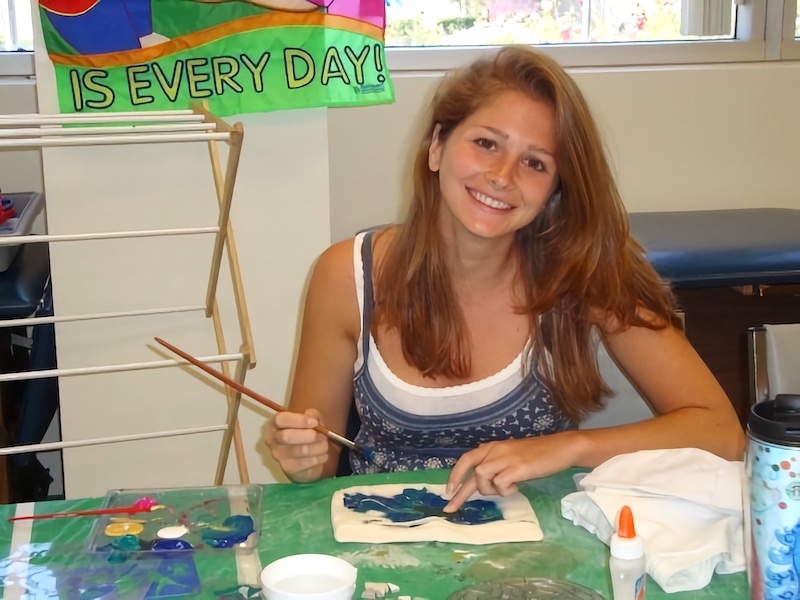
Me working on a skills project!!
This summer session is full-time and you are at school pretty much all day. I think the combination of being excited to start occupational therapy school and having this opportunity to be with all your classmates makes it feel less like “too much school” and more about the process of it all!
⋯
MS Walk ⟩
April 27, 2010, by Myka
Classes Getting Involved What are OS/OT?
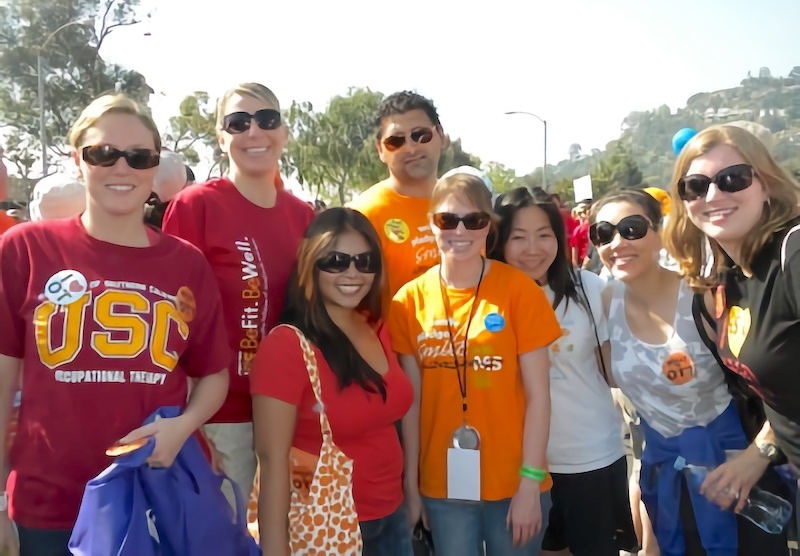
I had a great time walking in the MS walk with other students and clients from my Optimal Living with MS class.
This semester, I’ve been taking a class with clients with Multiple Sclerosis, an autoimmune disease that affects the brain and spinal cord. Many of these people have difficulties doing what they want and need to do, and often have fatigue and weakness. This is a 12-week course run by the MS Society, and participants come to USC and work with OT students in the morning, and PT students in the afternoon. We led groups for them such as Roles and Identity, Meaningful Activities, Adaptive Equipment, Energy Conservation, Stress Management, and Time Management, among others. I led the group on Advocacy and Assertiveness, which was really fun! A neat part of the class was the opportunity to meet with PT students who are also taking the class, and get to talk to them about what OT does for this population.
We just finished the class, and all of the participants shared their feelings about the experience. Nearly all of them stated that they came to the class to receive physical therapy, and didn’t even know what occupational therapy was! However, over the course of the twelve weeks, they came to really appreciate the unique role of OT in their illness management and health optimization. We look further than the body — we look at the desires, wishes, and struggles of the individual. We look at the psychosocial aspect of living with MS and dealing with functional limitations and loss of meaningful roles and activities. I learned a lot from the participants as they shared the lived experience of MS and I understood that MS does not define these people. As the participant I worked with stated, “I have MS, MS doesn’t have me!”
I was able to attend the Los Angeles MS Walk last weekend at the Pasadena Rose Bowl. Most of the students in my class went, and one of our participants was there as well. It was a great experience to see so many people come together for a cause about which they were passionate. As I tried to raise money for the walk, I met more and more people whose families had been affected by the disease. The walk signified hope, not despair, as people celebrated together to raise money to research for a cure to MS.
⋯
Social
Facebook Instagram LinkedIn TikTok YouTube