



Student Blog
Ciara

OT, ST, and PT: What’s the Difference? ⟩
April 13, 2026, by Ciara
What is Occupational Therapy? This is a question commonly thrown my way when I tell people my major. And, believe me, I have no problem answering this question as Occupational Therapy is a rather niche profession that is commonly confused with physical therapy and speech therapy. So, I thought it would be nice to thoroughly tackle this question by explaining how occupational therapy differs from speech therapy and physical therapy.
Occupational Therapy
Occupational Therapy is the holistic based health profession involving Occupational Therapist helping individuals gain independence in occupation regardless of an injury, disability, illness, or obstacle in their life. We refer to everyday activities that add value to one’s life as occupations; they are a key entity in OT’s goal to promote well-being and independence in the categories of physical, mental, emotional, and spiritual health.
What is involved?
Due to Occupational Therapy’s holistic nature and the various populations worked with, a day-in-the-life of an OT is extremely diverse. Some of the tasks OTs are involved in include redesigning the environment to be more inclusive to different conditions, treating children with autism or sensory processing disorders with self-care and social occupations, or helping adults to use adaptive equipment like dressing aids and eating aids.
A great source is to learn more about OTs work is USC Chan’s “Occupational Therapy in Action” page to see how OT’s are involved in various populations (pediatrics, adults, geriatrics, and mental health), while highlighting the Lifestyle Redesign® and Sensory Integration interventions provided at USC Chan:
Who do they treat?
Similar to ST and PT, OTs treat various populations; the graduate program at USC Chan allows students to gain experience with the pediatric, adult, geriatric, and mental health populations through practice immersions. For pediatric populations, it is quite common to find Physical Therapists, Speech-Language Pathologists, and Occupational Therapists working in the same facility. This past summer, I interned at a clinic where there were multiple PTs, SLPs, and OTs within the same facility to help children in a united manner.
What does the pathway look like?
Traditionally, the pathway includes a Bachelor’s degree (~4 years) and an Occupational Therapy Doctorate (~3 years). However, USC Chan offers a 6-year accelerated program where students can get both their BS and OTD degrees in 6 years, shaving off a year of schooling.
❗Personally, “Day in the lives” videos (on TikTok or YouTube) helps me observe and better comprehend what it’s like to follow suit in this career. Plus, finding creators who specialize in the career you’re pursuing can be a nice way to see what’s in store, what obstacles one may face, or any advice from their personal experiences.❗
If you’re interested in the BS-OTD program, watch USC Chan Undergraduate Ambassador Avery’s Day in the Life video:
Or if you’re interested in the OTD program, watch USC Chan Graduate Ambassador Cara’s Day in the Life video as a 1st year E-OTD student:
Speech Therapy
Speech therapy describes the treatment where a speech language pathologist helps one improve their speaking skills, communication skills, and use and understand other language skills. In fact, speech therapy may also be recommended for those who have a swallowing difficulty or hearing impairment that then impacts their speech.
What is involved?
Speech therapy activities can vary on the population, but usually speech therapy activities include word games, reading certain words out loud, helping using communication devices or sign language, exercises for using a hearing aid, and tongue and mouth exercises (this was an exercise I constantly did when I was younger!). The main areas of focus involve:
- Fluency
- Resonance
- Articulation
- Pronunciation
- Verbal and Written Language
- Swallowing
Who do they treat?
Personally, I took speech therapy for a few years in a school based setting in elementary school to help with the articulation of certain word sounds. However, speech language pathologists can treat both pediatrics and adults.
What does the school pathway look like?
Bachelor’s Degree (~4 years) → [Accredited] Master’s program (2-3 years)
Learn more about the Speech Language Pathology Master’s Program at USC:
Physical Therapy
The second question I get when I tell people my major is Occupational Therapy is “Is that like Physical Therapy?” Well, Physical Therapy involves treatment from a Physical therapist to help improve strength, mobility, and flexibility as well as relieve pain. It is common to see physical therapy incorporated into one’s life after surgeries or injuries, but a surgery or injury is not necessarily needed for physical therapy to be in one’s life.
What is involved?
Physical Therapy activities include exercises to improve strength, coordination, mobility, and flexibility, as well as more techniques and treatments such as massages and hydrotherapy. Treatment plans are various — some people may need PT for only a few weeks while others may need it for more chronic conditions. Some of the many conditions physical therapist treat include:
- Hip Injuries and pain: (e.g., post hip-replacement surgery)
- Sports injuries (e.g., ACL tears)
- Cerebral Palsy
- Back pain
- Muscular Dystrophy
Who do they treat?
Similarly, Physical Therapists work with various populations ranging from pediatrics to the older adult population.
What does the pathway look like?
Bachelor’s Degree (~4 years) + Doctor of Physical Therapy DPT (3 years)
Learn more about USC’s Division of Biokinesiology and Physical Therapy:
All these professions are essential and hold special places in people’s lives. What set apart Occupational Therapy from Speech Therapy and Physical Therapy for me was its holistic nature. The saying “There is more to a person than meets the eye” stuck with me as I gravitated more and more towards OT, and I’m so excited to continue my journey on the BS-OTD track at USC Chan.
The takeaway from this is not to say how one profession is better than the other, but rather to show how imperative each profession is in our society and how they are not opposing professions but rather supporting professions that work together to help a person feel their best!
⋯
From “The Pitt” to Puppies: A Week in the Life with Ciara ⟩
March 1, 2026, by Ciara
Every week truly is unique at USC. For me, I like to keep my weeks relatively consistent while also making sure to take advantage of going to school in Los Angeles. When I first got to college, I didn’t know if being involved in different spheres would be possible on top of my academic course load; however, I realized that balance is not something one waits to find but rather something that I have to create myself. So, I thought it would be nice to show a glimpse into my week and how I fit in fun activities, involvements, and academic commitments in a balanced manner.
Monday
Like most individuals pursuing careers in health, my Thursdays are centered around watching “The Pitt” as soon as 6pm strikes, so you can imagine my excitement when my professor announced that she was cancelling class because Noah Wyle, actor and producer on the Pitt, was coming to USC on Monday.
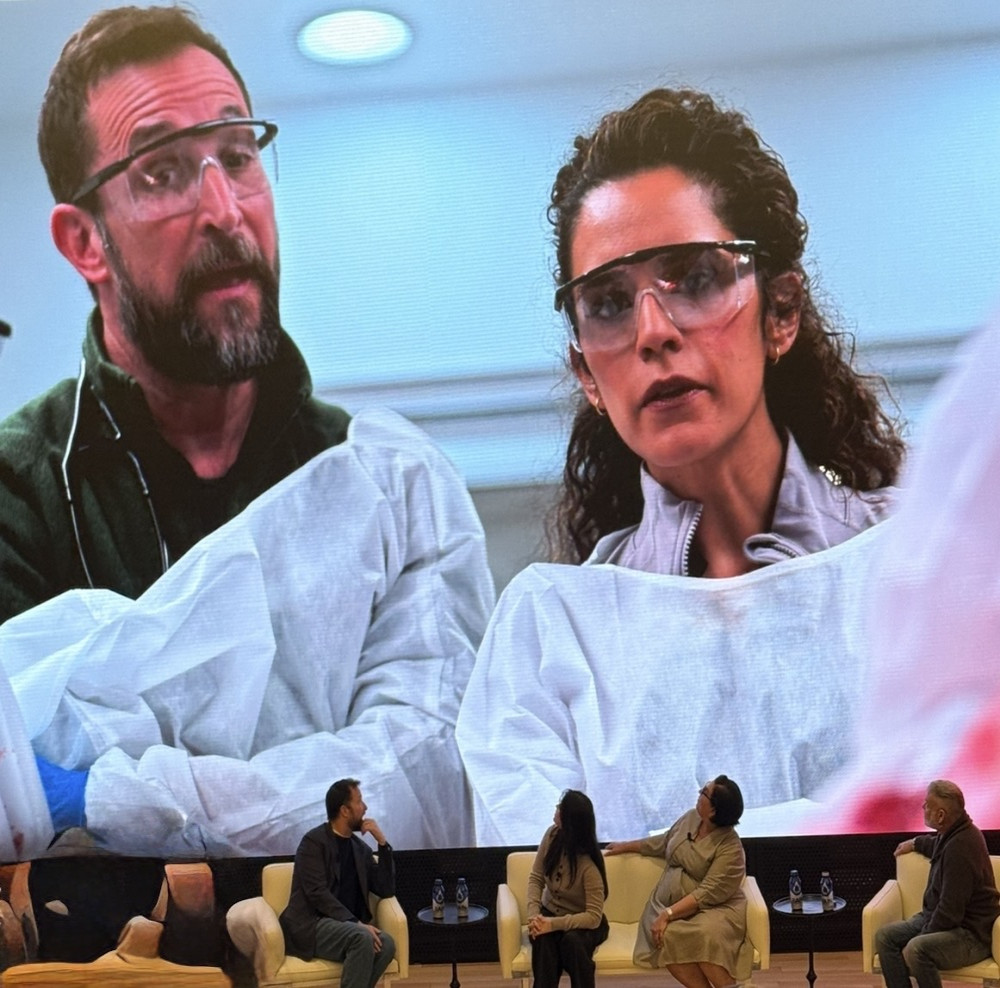
Noah Wyle, along with R. Scott Gemmill, Simran Baidwan, and Dr. Elizabeth Ferreira, was the keynote speaker for “Arts + Health: A USC Arts Now Symposium.” “The Pitt”’s impact was clear as Ginsburg Hall was bustling and packed with a variety of individuals — from med students to psych majors and (of course) OT majors — all eager to hear about the intersection of Health and Media. The keynote speakers gave us an engaging conversation that ranged from describing how art and health intersect to the important work of medical consultants on set, as well as the inclusion and representation shown through “The Pitt”’s cast.
Fun, educational events like this — particularly those from USC’s Vision and Voices — happen quite frequently at USC and are a great outlet to tap into that work-life balance. (p.s. to all my fellow “The Pitt” fans, don’t worry, Noah did mention #Huckleberry!)
⏰ Time spent in class and/or doing work: 4 hrs
Tuesday and Wednesday
Tuesday and Wednesday were more my “work” focused days. After my first class on Tuesday, I went to RA Welcome Day to celebrate being accepted to return as a Resident Assistant for the 2026-2027 school year!

Being an RA is one of my larger commitments, but I truly would recommend it for anyone interested. Besides the weekly RA meetings, I’m allowed to take initiative and plan events, such as floor programs, as they fit with my schedule. This position also allowed me to meet individuals in the ResEd community as well as professors, such as Faculty-in-Residence Dr. Celso Delgado (who is also an Occupational Therapy professor at USC Chan!). Besides work for my classes, I spent Wednesday making promotional content for a Faculty-in-Resident event at the California African American Museum that I was collaborating on.
⏰ Time spent in class and/or doing work: 5 hrs on Tuesday, 6 hrs on Wednesday
Thursday
Between my classes on Thursday, I usually go to Mudd Philosophical Library to catch up on work from the week or to start calendaring. Later on that day, I participated in an Faculty-in-Resident event that involved a tour of the California African American Museum as well as a FIXINS dinner. Not only was this museum visit part of my work as an RA, but visiting a museum personally is an incredibly enjoyable activity that I love to do in my free time; thus, an activity such as this one, encapsulates part of what work-life balance means to me.


⏰ Time spent in class and/or doing work: 3½ hours
Friday
After my morning Yoga classes (If you haven’t taken a PHED class at USC, I would definitely recommend Yoga by the way!!) I met up with my friend Gabby to go to a Puppy event on campus, where we got to make goodie bags for the Good Tails Rescue Team and pet some of the puppies they brought, which was a perfect way to end my weekday portion of the week!

⏰ Time spent in class: 4 hrs (but all my classes are Yoga which I LOVE!!)
Saturday
In honor of Saturday being the last day of Black History Month, myself and my friend Evan-Reese decided to go to the Black Market Flea, which housed over 150 black owned businesses to showcase their designs, products, foods, beverages and much more! It truly was a beautiful event with a vendor for every person’s interests. I ended up leaving with some jewelry, sunglasses, and a vintage bomber jacket, but I plan to be back very soon for some more trinkets and items!

⏰ Time spent doing work: 0 hrs (Rest days are important!)
While not every week looks like this, I strive for my weeks to encapsulate that college is not fully centered around grades but also the fun, engaging experiences you get to encounter along the way.
⋯
Surviving (and Thriving) During Finals Week: My Personal Study Tricks ⟩
November 6, 2025, by Ciara
With midterm season finally ending and finals being a few weeks ahead it is officially the marathon portion of the semester. Between group presentations, essays, and late-night cramming for exams, I know firsthand how hard it is to balance studying for all your courses while also trying to keep your sanity unscathed or to put it plainly not “crash out”. Those 24/7 Leavey Library cram sessions don’t have to be the way you study for this upcoming exam session. I like to apply the “work smarter, not harder” saying to my study methods, so if you are a little stressed for this upcoming final exam period and are on the prowl for some study tips then follow along:
Have an Idea of Yourself:
My biggest advice is simpler than one would think: know yourself. This can mean various things in the study context, but I like to think about this in terms of knowing what environment works best for you. For instance, coming into my freshman year, I didn’t exactly know what environment worked best for me but through trials, I quickly learned that I don’t work best in a group studying environment. It’s not beneficial for me to spend a chunk of my study time in groups when I usually find myself getting distracted or having my mind wander amongst the different personalities in the group.
On the flip side, if you work better and are more motivated in groups, then try to organize study sessions with classmates; a great way to truly comprehend content in a group setting is trying to teach it to your friends.
Leavey Library offers study rooms that you and some friends can book; this environment is the perfect mix of group work while also not having too many distractions, so if you’re interested, you can reserve study rooms (or study pods if you like to go solo) here. Whether you like group studying or solo studying, it’s good to stick to your strengths during this final period especially with how many exams you may have during a rather short period.
My Dear Friend: Quizlet
After quite a few exam periods, I don’t know how I would survive without Quizlet. I love studying with Quizlet for a few reasons.
First, you can use it wherever you have the app. When I have downtime such as waiting in line in the Village or sitting on the Metro, I pull out my Quizlet and already start familiarizing myself with the content I’m studying.
Secondly, I feel like making the Quizlet yourself forces you to re-read notes and try to understand the content so that you can later test yourself. If you want to go beyond, I find it helpful to make practice exam questions after reading my notes and put them in a Quizlet and use the “Test” function to make my very own practice tests.
If you want to try the entire “Ciara Study Method,” then accompany Quizlet review sessions with writing and explaining concepts using a whiteboard. The combination of memorization-based studying provided by Quizlet and the visualization and active recall based studying provided by using whiteboards leaves me feeling my most confident going into exams.
Plan Ahead:
This next piece of advice may scare the community of procrastinators, but during the final period, I find it vital to plan ahead. For me, I use Google Calendar to put my exam dates and deadlines (ex: essays) in. Based on that, I can put when I should start studying for my exams, which is usually at least 3 days ahead of the exam during final periods.
If you find yourself always studying at the last minute I would highly suggest starting to start calendering or even starting out with writing To-Do lists for yourself. The last time I found myself procrastinating during final exam periods, I felt so stressed throughout the pre-exam period and during the actual exam. I felt more confident and performed academically better when I spaced out my studying amongst several days with breaks rather than doing it all in one night with no breaks, which takes me into my next point…
Take Breaks:
Going hand in hand with planning ahead, I find it essential to give myself breaks. I know the temptation to work for hours straight is strong but simply said: neither the mind nor body can run on fumes. I prefer to study amongst several days so that I naturally give myself breaks and time to enjoy college life and go explore California with my friends.
When I am running low on time, I like to do the Pomodoro technique. With the Pomodoro technique, one works in 25 minute intervals separated by 5 minute breaks and then a longer break after several intervals; the intervals characterizing the Pomodoro technique have shown benefits in improving focus, and combatting burnout and procrastination. If this technique sounds interesting to you, click here for a free Pomodoro timer.
Studying for finals can be stressful and overwhelming but it doesn’t always have to be. These 4 main tips help me feel academically prepared for exams while still taking care of my mental health. When I manage my time correctly, study with intention, and give myself breaks, I find myself saying “bon voyage” to burnout and panic.
Good luck Trojans and future Trojans, and during this upcoming exam season remember: be kind to yourself and trust the work you’ve put in!
⋯
The Secret to Balance: Nature ⟩
September 24, 2025, by Ciara
Between deadlines, projects, internships, and the never-ending temptation to doom-scroll on TikTok, I know first hand how hard it is to maintain balance and to not feel overwhelmed by stress. But let me let you in on a secret that helped me become the most balanced I’ve been: the best way to clear your head isn’t coffee, energy drinks, or back-to-back all-nighters at the library, but rather a relaxing day spent exploring nature.
Coming from out-of-state, I was concerned that I would become stressed with school and not have access to the usual methods I had to calm me down at home (which were usually playing with my two dogs — Star and Sky — and my mischievous cat, Luna). Fortunately, one of my first classes at USC was OT-250, where I quickly realized that occupations — meaningful activities that hold value in one’s life — have a direct correlation with one’s overall well being. So I set on a path to find an occupation that both filled my life with joy and allowed me to get away from the busy life of undergrad and relax; eventually this path led me straight to my new favorite occupation: exploring nature! I realized that while academics fed my mind, nature fed my soul. So here’s how and why you should make room for both!

Visit local beaches
During my freshman year, my friend group helped support my quest to make balance a priority in my life, and they were all also in love with the idea of doing so through nature. Visiting local beaches with a friend group is a fun way to immerse yourself in nature. Not only does going to beaches with friends make transportation easier, but it’s also nice to have someone there with you to share the experience. So far, I’ve been to Venice Beach, Manhattan Beach, Santa Monica, and Malibu, and Catalina Island! Malibu was my most recent adventure and the first time I went on a hike in California. It was nice to get out of my comfort zone by adding the physical challenge of a hike to the usual relaxation I find within nature. If you are an out-of-state student like myself or do not have a car on campus, I highly recommend using the metro with your U-Pass or renting a car with a group of friends (I recently used ZipCar and it is beginner friendly!).

You can explore nature anywhere
Exploring nature also allows you to explore the world! I was concerned that I would lose touch with my new love for nature when I went back home this summer, but nature is truly all around us. I found that outdoor walks and gardening allowed me to still engage in nature-based occupations at home. When I went on a cruise this summer, I even convinced my dad to do a nature-based excursion, where we went on a hike and slid down waterfalls in the Dominican Republic. It was the perfect duality of tranquility and thrill. Moral of the story, don’t let your mind limit you on how you can engage with nature, nature is everywhere!

Easy to add into your routine
Exploring nature is rather easy to incorporate into your daily routine. Not every interaction has to be to along a hiking trail or at a beach; you can get your daily dose of nature by taking an outdoor walk, studying on the lawns on campus, or starting to care for a small plant (tip: start with a succulent if you’re a beginner like me). I also found that you can incorporate nature into other occupations. Before finals season, my friends and I went to The Getty and found ourselves drawn to the Garden Exhibit. It was so calming that we didn’t even notice we spent all our time there! If you’re a music lover, try taking a walk outside while listening to your favorite playlist! Or if you love journaling, try writing your next entry under a tree!

Why Nature?
You may be wondering: why? Well, nature-based occupations have several health benefits:
- Depression and Anxiety: Nature’s calming effect reduces cortisol, which reduces stress and anxiety.
- ADD and ADHD: Spending time in nature improves attention and cognitive function, which can help with focus and clarity.
- Human health: being outdoors and engaging in physical activity also encourages sunlight exposure, which can help regulate circadian rhythms, boost Vitamin D levels, and improve sleep quality.
Exploring nature has allowed me to explore myself: Who is Ciara? What works for me? What doesn’t? How am I genuinely feeling right now? Nature has seemingly become my safe haven and has brought me closer to my community, my friends, and most importantly, myself. The balance involved with nature-based occupations is only the tip of the iceberg of benefits it has in one’s life. If you’re interested in starting your nature journey and don’t know where to start, consider the USC Peace Garden; you can check out the updated hours. So, the next time you find yourself overly stressed, don’t panic: take a break outside, let your mind reset, and come back to your task ready to take on the day.
⋯
Social
Facebook Instagram LinkedIn TikTok YouTube