



Student Blog
Living in LA

Abilities Expo 2026! ⟩
April 7, 2026, by Trinity
Getting Involved Living in LA Patient Care
On March 29th, I had the opportunity to go to the annual Abilities Expo held in Long Beach, California with two of my good friends from the program. This is a huge event where vendors, advocates, and presenters come together to share products, events, and opportunities.
As an occupational therapy student, this event taught me a lot about what kinds of adaptive equipment are out there. I learned about organizations that focus on adaptive sports and activities. That will be important for me to know so I can make good recommendations to my future clients and patients, both about devices and resources. I also got to interact with many individuals who are disabled and learn about them and their stories, another OT essential.

Some of the coolest equipment I saw included a portable bathtub, an adaptive rock climbing wall, a bowel program support, a standing frame, and adaptive grips for tool use. Most of the equipment was designed or endorsed by a disabled person.
Not only were they showing equipment, but they let us demo some equipment as well. I got to trial an independent lift system and a power chair. In short, it was an occupational therapist’s dream come true!


There was a performance by the Rollettes, a famous dance group known for empowering people with disabilities. Their performance was off the charts! Check their website here for more info!
At USC Chan, we have an assistive tech class specifically designed to help students become familiar with the equipment and devices commonly used by clients. In this class, you learn how to measure someone for a wheelchair, use different modalities for turning electronics on and off, complete a case study and a letter of medical necessity for a client who needs equipment, and learn how to 3-D print. The Abilities Expo was a great addition to that class and a reminder that technology is always changing and becoming better. We need to stay in the know so we can provide the best care and give the best resources.
If you are interested in attending the Expo next year, good news! The dates have been announced: January 14-16, 2027 in Long Beach, California. Check their website for more information and to stay informed!

The next part of the blog is by Cara, another ambassador, who attended the Expo with me!
–
Until recently, I didn’t even know events like the Abilities Expo existed. I’m thankful to Trinity for inviting me, as it was a great opportunity to expand my understanding of how I can better support and advocate for my future patients.
In the Adult Rehab Immersion, I’ve learned a lot about mobile devices and adaptive equipment and how those both can improve patients’ independence, autonomy, and participation in their daily routine. It was cool getting to see many of the wheelchairs, arm supports, and accessible transportation services that I learned in class at the Expo. I, too, drove the power wheelchair and felt like I was in a Fast and Furious movie.
The Expo also featured the latest gadgets and innovations in assistive technology, from portable bathtubs and robotic feeding devices to specialized phone cases for carpal tunnel and smart beds for children with special needs. There were new fashion trends on display too such as fastening a shirt or jacket with magnets.
What stood out to me the most, though, was interacting with the exhibitors, many of whom live with a disability themselves. From cerebral palsy to spina bifida and spinal cord injuries, I was in awe of their resilience. Hearing their lived experiences redefined “disability”, a word that society often views negatively. Individuals with disabilities are not less capable. Rather they’ve just learned a new way of doing things, like anyone else adapting to life’s constant changes.
There was also an ally who wrote a comic book series about superheroes who have a disability, proving that anyone can be heroic. Selfless, empathetic individuals as such reminded me how important it is to provide services that are client-centered to more fully understand the patient’s needs while empowering them to take ownership of their lives.
Overall, the Abilities Expo was enlightening and I feel better equipped as I prepare to join the next generation of healthcare providers. Whether you live with a disability, are a caregiver, or a healthcare provider, I encourage you to attend to help move the needle towards understanding and kindness in society, so we can all thrive.

⋯

Mural Therapy: Arts Justice Advocacy and School-Based OT Intervention ⟩
March 24, 2026, by Makayla
Community Getting Involved Living in LA School/Life Balance
Every Friday, I have the pleasure of volunteering with USC Chan alumnus and school-based occupational therapist Serena Au, servicing students (ages 4-16) with moderate to severe disabilities at a special-education school.
Over the past winter, I participated in Mural Therapy, an interdisciplinary and accessible arts program that OT Serena founded at this special-education school in South Central Los Angeles where, every semester, professional artists are invited to collaborate with the students to provide culturally responsive art education and community-based healing.
While embracing the rich cultural scenes of L.A. public art, Mural Therapy results in the students painting an entire school-wide mural that helps beautify the campus and surrounding neighborhoods as well. This collaboration involves everyone on campus, including students, muralists, occupational therapists, physical therapists, healthcare assistants, special education teachers, and surrounding community members.
While Mural Therapy supports their mental and emotional health, students build connections between life skills development and occupational therapy treatment interventions. In doing so, students develop and work on a wide variety of occupational therapy goals, such as shoulder flexion/extension, fine motor skills/grasps, postural control, and bilateral coordination. Here, public art and graffiti are legitimized as pedagogical and therapeutic tools.

Evolution of Blue - Dodgers Mural
Last year, communities all over Los Angeles were at the center of constant environmental and political turmoil, and at its center, students at this special education center continuously navigate the intersectionality of their different identities and multiple layers of marginalization, including disability stigma, racialized barriers, and economic inequity. Yet in the wake of devastation, this year’s mural focused on painting over loss with color and storytelling, transcending trauma into collective artistic, educational, and social change.
Rooted in the themes of resilience and affirmations of L.A. culture, OT Serena decided to collaborate with a community muralist, Mister Alek, to paint a Dodgers mural, a profound symbol of intergenerational city pride embraced by the surrounding school and neighborhood community.

Mural Therapy made it to the news!

Muralist Mister Alek and I

Mister Alek next to his iconic “LA” sign

Stenciling painting shirts
Before every mural, there is an extensive process in educating and engaging the students, faculty, and community members alike. This includes stenciling, decorating painting shirts, coloring the artist’s coloring pages, completing worksheets, and engaging in thoughtful lessons and discussions on the meanings and representation behind the mural to come.

Mister Alek and Dodgers Coloring Sheets by the students

Hanging the students’ coloring sheets on the fence next to the mural
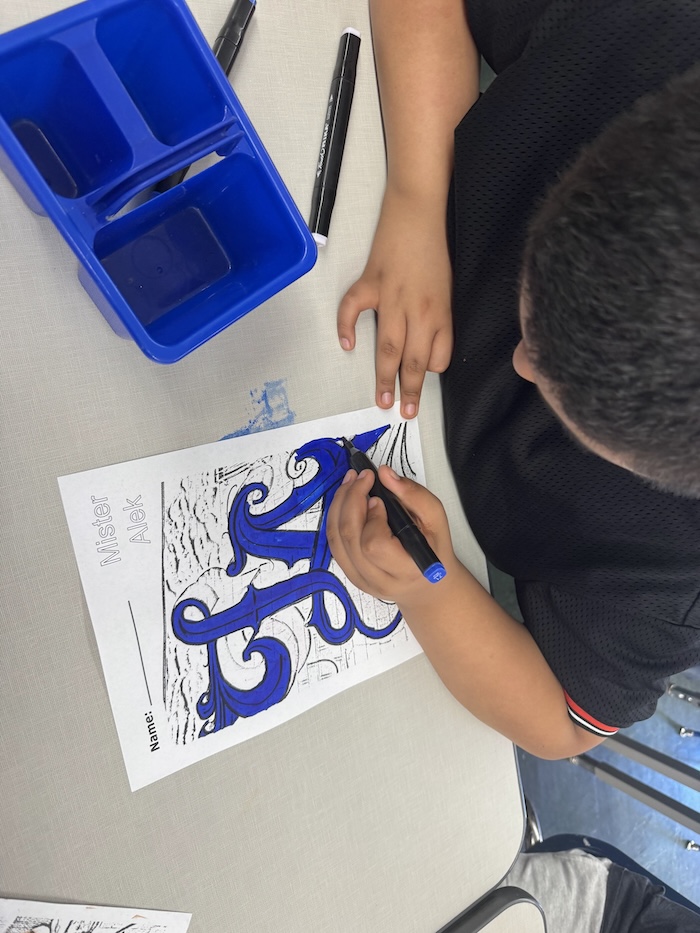
Mister Alek coloring sheet
For the Dodgers Mural, I sought to create a lesson on the history of the Dodgers, the sport of baseball, as well as educate on how disability representation in Major League of Baseball (MLB) remains prevalent. Prominent and outspoken figures have reshaped dominant narratives about individual differences that affect the field of play, including pitcher Jim Abbott, born without a right hand due to amniotic band syndrome, and African-American MLB player Curtis Pride, who was born deaf. Advances in technology have enabled adaptive versions of engaging with baseball for the blind and visually impaired, such as beep baseball leagues or OneCourt tactile tablets for fans to use at MLB stadiums.

Teaching a Dodgers Lesson to the students

Teaching about Jim Abbott - MLB pitcher born without a right hand
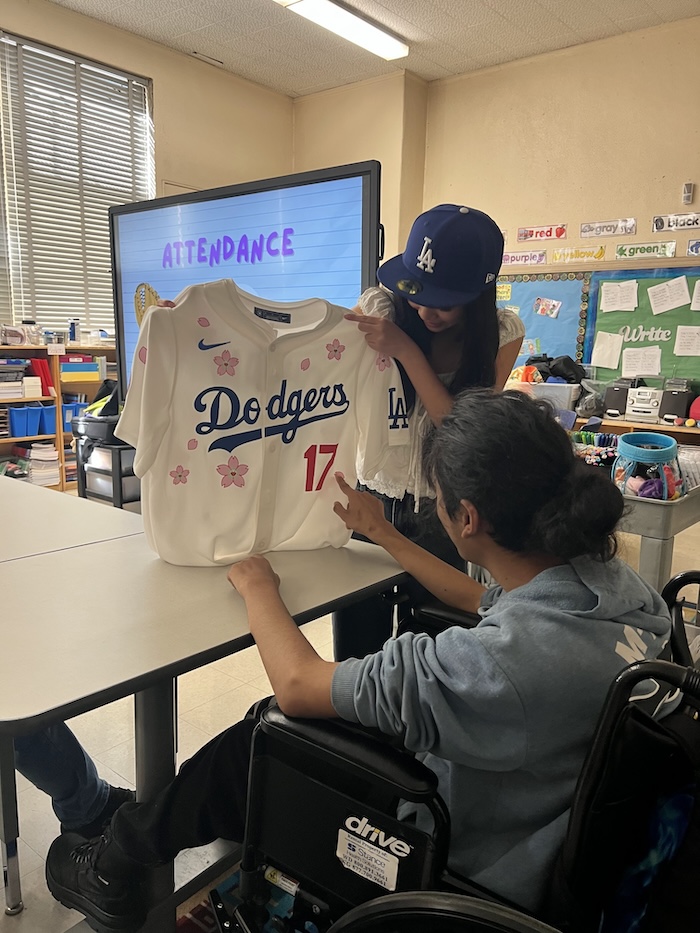
Showing my Dodgers jersey and their tactile features
Together with the students, we scaled the entire wall and painted the background. Students painted high, low, and across all the different directions, watching their brush strokes make permanent marks in ways that would be visible and celebrated publicly. It was really so powerful seeing students who are wheelchair-bound and rarely stand up willing to stand for long periods of time for something so cool, joyful, and regulating as the act of painting.
Through an OT lens, I recognized that the index finger isolation used to position a spray paint can on a vertical surface mirrors the same fine motor patterns students use to scroll or select on Augmentative and Alternative Communication (AAC) devices on a horizontal surface. This skill transfer across different mediums and environments demonstrates just how powerful mural therapy transcends artistic expression into occupational therapy interventions in real time.

Students painting the base of the mural

One of my favorite students - using his standing wheelchair to paint

Here is me painting fills
Mural therapy is not about painting a wall; it is creating a sensory and emotional experience because students are engaged in the texture of the wall, the consistency of the paint, the bristles of the brushes, and simply being present in the space.
Many students have diagnoses that make them sensitive to sensory input; however, they might need something like bright colors to pay attention or auditory input of the sounds of a shaking spray paint can. The high sensory and high visual impact that a mural can give is so important, as they act as mirrors to the students and give them validation in their artistic expressions.

Different shades of spray paint cans

Watching Mister Alek spray paint an eye
Embracing the power of sports and teaching about the Dodgers is something that I hold near and dear to my heart. My family traces its roots to Lincoln Heights, just behind Dodger Stadium. I was raised in the South Bay, where I leaned on Asian baseball and basketball leagues to shape my sense of belonging and as anchors of my identity. Watching Shohei Ohtani take the field in Dodger blue or remembering the cultural impact of NBA player Jeremy Lin reinforced how Asian athletes can serve as powerful counter-narratives, disrupting longstanding stereotypes and affirming that we belong not at the margins of the game, but at its center.
These experiences fundamentally reframed how I conceptualize mobility, not just as physical movement, but as narrative and social possibility.
When I first learned to spray paint through this mural project with muralist Mister Alek, I had the pleasure of learning how to spray paint clouds and graffiti fills. Here, I experienced a renewed sense of freedom, a feeling reminiscent of being a child again. The spray paint moved quickly, fluidly, without hesitation, expanding across the wall in ways that felt limitless. That feeling embodied mobility: the ability to move, to explore, to take up space without restriction.

Mister Alek and I on the lift

Learning to spray paint clouds

Learning to spray paint fills of hair

Learning to spray paint fills of clothing
Mobility is often framed as purely physical attributes, but it is also social permission. It is about who is told they are capable of moving forward and who is told to stay still. For many students with disabilities, the message they receive is subtle but persistent: you are not smart enough, your body does not fit the mold, you are not athletic. This narrative restricts their personal potential long before physical barriers ever do.
Yet athletics has repeatedly proven that mobility can be redefined.
Coming off winning back-to-back World Series championships, the Los Angeles Dodgers players represent more than the name on the front of their uniforms. Rooted in the historic Elysian Park neighborhood of Los Angeles, the Dodgers have long been a focal point for surrounding Latino, Black, and Asian communities, and have long been present at the crossroads of social justice, solidarity, and community outreach. Known for their diverse fanbase and initiatives toward underserved communities, the team is a staple of L.A. culture and intergenerational city pride. Their presence reflects a broader story about who gets to occupy space — and who gets to be celebrated within it.
Mobility, curiosity, and excitement are not just themes of sport but foundations of inclusion. Within schools, athletics function as formative spaces where identity and belonging are not only expressed but also validated and legitimized. Murals serve as a direct reflection of the reality around us. When students participate in this mural, there is an public acknowledgement that they are contributing to something greater than themselves. Students perceive themselves adjacent to these positive role models through a lens of great admiration and reflection, bestowing greater agency and resolve in their own challenges.

Mister Alek, OT Serena, and I
Seeing themselves in the projection of the Dodgers players, this representation sets a precedent for newer generations to acknowledge that they can create archetypes of their own narratives. Promoting diverse athletic representation in schools fosters a critical appreciation for deconstructing structural barriers and validating marginalized experiences, serving as a liaison for cultivating a more inclusive world at large.

The Women of the Dodgers Mural Therapy Team with OT Serena and Dr. Natalie (Past Student Ambassador)- All different generations representing USC Chan!
As an aspiring occupational therapist, my experience with mural therapy has reshaped how I understand education as a health, art, and embodied practice. Situated at the crossroads of USC, South Central, and disability communities, this experience has expanded how I envision my future field of practice.
Through shared creation, community belonging becomes tangible and imperative, challenging stigma surrounding graffiti artists, disability, and the individuals we often overlook in our daily lives. I look forward to participating with OT Serena for future murals, and I can’t wait to see all walks of life embrace and continue the legacy of the mural for years beyond my time!
⋯

An International Student’s Guide to Learning to Drive in Los Angeles ⟩
March 20, 2026, by Angel
Housing and Transportation International Life Hacks Living in LA
For many international students, relocating to Los Angeles means navigating far more than a new academic environment. It involves adjusting to a vast city shaped by freeways, long distances, and a culture where mobility is closely tied to independence. Among the many transitions we face, learning to drive often becomes one of the most defining milestones because it gradually transforms into a symbol of confidence and belonging.
For many students, the journey toward becoming comfortable behind the wheel reflects a deeper experience. It blends uncertainty, determination, and the satisfaction of mastering something that once felt intimidating, sometimes while gripping the steering wheel a little too tightly.

The DMV: A Rite of Passage
The first step in this journey is often the most intimidating. The DMV is known for its long lines, complex requirements, and unpredictable outcomes. For international students, the experience can feel even more daunting because it requires navigating documentation, identification rules, and procedures that differ significantly from those in our home countries.
Yet this stage also becomes a point of connection. Standing in line with other students, comparing paperwork, and exchanging stories turns the DMV into a shared rite of passage. It is the one place where everyone silently agrees that we have no idea what is happening, but we are all trying our best.
Luckily, we need all the convenience we can get, and several DMV locations are conveniently close to USC Chan, which means students can get to their appointments and practice sessions without feeling like they are embarking on a cross‑county expedition.

Developing Skill Through Consistent Practice
Driving in Los Angeles presents its own unique challenges. The city’s fast paced freeways, complex intersections, and dense traffic patterns require patience, repetition, and a willingness to learn through trial and error. Many students find themselves practicing in the same neighborhoods repeatedly, gradually becoming more comfortable with the rhythm of the roads, and occasionally discovering a new café purely because they missed a turn.
Working with instructors further strengthens this foundation. Their calm presence and structured guidance help students refine technique, correct unsafe habits, and build confidence. A particularly effective strategy is narrating each action aloud, a method that reinforces awareness and demonstrates intentionality. It may feel awkward at first, but saying “checking mirrors” out loud is surprisingly grounding, even if your instructor already knows you have mirrors.

The Moment of Passing
Receiving a passing score on the driving test is more than an official achievement. It represents resilience, adaptation, and the ability to navigate a system that once felt overwhelming. Whether the test resulted in three errors or ten, the outcome is the same. Students gain a new sense of independence and a tangible reminder that growth often happens in unfamiliar territory.
For many, the celebration is simple. It is a drive thru meal enjoyed alone or shared with friends after the test. Sometimes the victory meal is joyful, sometimes it is reflective, and sometimes it is simply because the adrenaline crash makes you hungry.


Practical Tips for International Students Learning to Drive
Learning to drive comes with plenty of humor and unpredictability, but a few practical strategies can make the process much easier:
- Practice near your DMV. Test routes are often located within the same neighborhood.
- Narrate your actions while driving. Statements such as “checking mirrors” or “slowing down” help maintain focus and demonstrate awareness.
- Review traffic signs thoroughly. Pay attention to uncommon or situational signs that may appear during the test. For example, keep an eye out for the ‘No Left Turn Between 3 and 7 PM Except Sundays’ sign, which feels like it was designed specifically to test your problem‑solving skills.
- Approach four way stops with confidence. The first vehicle to stop proceeds first, and hesitation can create confusion.
- Match freeway speeds when merging. This ensures smoother transitions and safer entry onto high speed roads.
- Bring all required documents and extras. Unexpected requests are common, and additional documentation can prevent delays.
- Stay calm. The driving test evaluates safety rather than perfection. Even seasoned drivers occasionally forget which way to turn their wheels on a hill.

Why This Milestone Matters
Learning to drive in Los Angeles is not merely about transportation. For international students, it is a testament to adaptability, courage, and the willingness to step into discomfort. It reflects the broader journey of building a life far from home, one filled with challenges, small victories, and moments of unexpected pride.
At USC Chan, we often talk about growth as something that happens through meaningful engagement, supportive communities, and experiences that stretch us. Learning to drive becomes one of those moments. If we can navigate the DMV, the 405 freeway, and our own nerves, then we can navigate the academic, cultural, and personal challenges that come with studying at USC Chan. This milestone reminds us that independence is built gradually through persistence and community support.
Here is to safe drives, late night snack runs, spontaneous road trips, and the confidence that comes from mastering something new. Here is to every international student learning to thrive in a new city, one skill at a time!

For students who would like additional guidance on obtaining a California driver’s license, USC’s Office of International Services provides a clear overview of requirements and procedures. You can find the full details here.
⋯
My Sponsored Weekend Trip to Catalina Island Care of USC ESA ⟩
December 19, 2025, by Makayla
Community Getting Involved Living in LA School/Life Balance
One of the amazing perks of being a USC student is the numerous free experiences that we can take advantage of throughout the school year. This semester, the USC Environmental Student Assembly (ESA) hosted its annual, fully funded, overnight trip to the USC Wrigley Institute for Environmental Science on Catalina Island. This free opportunity was one that I simply could not pass up, and I was lucky enough to be able to join their program. Especially during these stressful times in the middle of the semester that are filled with the never-ending stress of deadlines and midterms, having the opportunity to engage in nature-based occupations is essential. In doing so, participating in restorative and rejuvenating practices contributes to our sense of self and occupational awareness, not only for our overall well-being but also for our school performance.

We made it to the USC Wrigley Institute!
During my trip, I was able to stay at USC’s own, one-of-a-kind satellite campus at the Wrigley Marine Science Center on Catalina Island, with free room and board included. It is an active research facility and living lab where students and researchers uniquely investigate environmental and sustainability initiatives while immersing themselves in the pristine natural environment on Catalina Island. Here, I embarked on a weekend trip that I won’t forget, where we hiked through scenic views, snorkeled in the deep waters of rich marine life, kayaked across the rushing waves, and learned invaluable research from current students and USC researchers alike.
Saturday
6:45 AM
My friend and I loaded our duffel bags into the charter bus bright and early, excited to head to Catalina Island. First, we drove down to San Pedro to go to the Southern California Marine Institute, where our boat, Miss Christi, was docked. After some pictures and a safety briefing, we were on our way to the USC Wrigley Institute by 8:00 AM. While it was chilly in the morning, my friends and I sat on the boat’s deck to enjoy the fresh air and take in the vast sea around us

The Miss Christi boat

Off at sea!

Gorgeous views from the boat’s deck

USC Wrigley Institute
10:00 AM
We arrived at the USC Wrigley Institute and loaded into the campus. We had a trip briefing and mandatory campus orientation before we checked out our rooms and got ready for our first activity of the day. I learned so much about the rich history of the campus and local ecosystems, as well as their sustainability efforts, experiential learning programs, and research initiatives that advance meaningful work in helping our planet. The rooms were very spacious, just like a normal dorm on campus, but what was neat was that they also provided towels, blankets, and pillows.

Hiking with my friend

Stunning views on the top of Catalina Island
10:30 AM - Self-Guided Hike
My first activity of the day was a self-guided hike on Deer Valley Loop Trail with my group, where we were able to hike through the lush greenery and take in the scenic views of the ocean and the USC Wrigley centers. This hike was definitely not the easiest at the start, with winding paths of uneven terrain and prickly pear cacti, especially in the hot weather. However, it was definitely worthwhile, as it was a great way to start the day and get some exercise in. Along the footpath we were able to spot a deer on the way down! Then at 12PM, we had a tight window to eat some lunch and head to the next excursion.

A deer spotted on the Deer Valley Loop Trail

Hiking through the Deer Valley Loop Trail
1:00 - Snorkeling
Next, we went snorkeling in the Blue Cavern Marine Protected Area, home to California’s richest marine habitats. We suited up in our provided wetsuits, fins, and snorkeling gear, and we were well on our way. While snorkeling in the deep waters of the channel, I saw so many Garibaldi fish perusing the rocky reef kelp forest and graceful eelgrass swaying by the ocean’s currents. Gazing into the Garibaldi fishes’ eyes, it was cool to knowing that they see me as much as I see them. As I traveled further, I saw a Halibut on the reef’s sandy bottom and many marine mammals and seabirds in the distance. This was such an awesome experience, especially being able to interact with the marine life up close.

My friend and I gearing up in our wetsuits

Post-Snorkeling: Tired but worthwhile!
3:00 - Hyperbaric Chamber Tour
After snorkeling and freshening up in the dorms, we headed down for the Hyperbaric Chamber Tour. As one of the only emergency medical facilities in the country set up to treat diving emergencies 24/7, year-round, hyperbaric chambers provide the proper treatment for scuba diving accidents. This includes treating decompression sickness and air embolisms that can be permanently disabling and sometimes fatal. How cool is it that USC has these facilities right on the waterfront of its own satellite campus for medical and research advancement?

The interior of the Hyperbaric Chamber

Our group at the Hyperbaric Chamber
6:00 PM - Dinner and Smores
Following all of our excursions for the day, we returned back to the dorms to shower, get some homework in, and take a quick nap before heading to the dining hall for dinner. After, we had some campfires going where we roasted s’mores to cap off the night.

Making s’mores in the campfire

Yummy s’mores!
Sunday
5:45 AM - Sunrise Hike
On Sunday, we woke up bright and early to catch the sunrise. Getting up, especially after a long day before, was no joke. However, we all went to the dining hall to grab some hot chocolate and made our way with picnic blankets to see the sunrise. Taking in the calm of the ocean was very peaceful and complemented the surreal sunrise right before my eyes. After taking lots of pictures, we headed back to the dorms to have breakfast at 7:30AM and check out of our rooms by 8:30AM.

Sunrise on Catalina Island

Catching the sunrise - bright and early!

Group Sunrise photo - hot chocolate in hand!
9:00 AM - Kayaking
Our excursion for the day was kayaking within the Blue Cavern Marine Protected Area and beyond. I paired up with my friend to kayak around the island and even went a half mile off the cove to Bird’s Rock, a flat, oval-shaped island with so many birds perched on it. Looking down, we saw the amazing marine life below us, and while looking around the island, we saw other docks of boats touring the island as well. I couldn’t believe how far we went out and how deep the water was below us. After almost 3 hours out in the ocean, we headed back for lunch at 12PM.

Preparing to go kayaking

Views from the Blue Cavern Marine Protected Area

Kayaking with my friend!

Kayaking around Catalina Island
1:30PM - Departure
Sadly, my weekend trip on Catalina Island came to a close as our boat, Miss Christi, departed Catalina Island to take us all back to the mainland and arrive at the Southern California Marine Institute. While I was so sad to leave, I took in the rich scenery on the boat’s deck as we traveled back to the mainland. I put my headphones on since the rudders of the boat were very loud and watched the endless blue waves crash next to us and some seagulls that had followed us up above. To my surprise, we were able to catch a pool of dolphins swimming right next to our boat. They gracefully jumped out of the water, and I was in awe at how close we were to them. I couldn’t believe it! We arrived at the Southern California Marine Institute shortly after, where we met our charter bus that took us back to the USC campus at 3:30PM. And that was my trip!

Dolphin spotted on the way back from Catalina Island!
This trip was definitely a fever dream, being able to escape the busyness of college while finding much-needed calm in the midst of chaos. Especially in the thick of a busy fall semester, these worthwhile experiences give me clarity in hard or challenging moments that better days are to come. I am reminded to keep moving forward and that great moments can and will happen again in different ways, with different people, and in different places!
This trip served as a reminder in recognizing what a privilege it is to attend USC and have access to so much amazing programming. Having participated in this trip hosted by the USC Environmental Student Assembly (ESA), I was surrounded by many environmental studies and biological science majors. I am neither of those majors; however, I am so lucky to have been able to get to know so many new people that I would not have otherwise known or had any classes with. So, to anyone reading this, I highly recommend taking a chance at joining a new club or program on campus where you could meet so many people and communities that you would have never crossed paths with before.
Rewarding and fulfilling experiences are out there and are free; you just have to look for them!
⋯
My Favorite Hidden Study Spots at University Park Campus ⟩
November 5, 2025, by Avery
Community Life Hacks Living in LA School/Life Balance
Happy Midterms season, Trojans! As I am now in my third year living and studying on USC’s University Park Campus (UPC), I thought I’d share some of my favorite, and often overlooked, spots to study. Whether you’re gearing up for midterms, catching up on readings, or squeezing in those final essay pages, finding the perfect study spot can completely change your productivity (and your mood). Here are some of my favorite hidden spots at UPC to hunker down and knock it out.
Category One: Coffee shops
My favorite way to study is with a fresh iced latte and a good friend across the table. My two favorite spots near UPC for just that are Ministry of Coffee (MOC) and Eruta Nature.
Ministry of Coffee is tucked right next to the Trojan Catholic Center. It offers both indoor and outdoor seating, plus plenty of coffee, matcha, and pastry or lunch options to power you through the afternoon.

Inside of Ministry of Coffee

Studying outside of Ministry of Coffee with a friend
BONUS: Right above Ministry of Coffee is the Trojan Catholic Center library. It’s the perfect spot if you need a quieter, more peaceful place to focus. I like to take the stairs up to the library when I need to switch things up.
Eruta Nature, located inside Rock & Reilly’s in the USC Village, is another gem. By night, the space transforms into an Irish-themed pub and sports bar, but in the mornings, Eruta Nature serves up freshly baked bagels and excellent lattes. You can almost always find a table to sit at, and their coffee-and-bagel combo deals are hard to beat.

Desk, computer, bagel, and coffee at Eurta Nature
Category Two: Library Hidden Gems
Everyone already knows about the big two (Leavey and Doheny Library). These two huge libraries hold hundreds of students studying every day. However, there are some lesser-known hidden library gems on campus too.
The USC Hoose Library of Philosophy sits on the north end of campus, just above Mudd Hall. It’s hard to describe this library as anything but magical. Whenever family or friends visit campus, I always make sure it’s on the must-see list. It’s that beautiful. If you want to romanticize your study session and feel like you’ve stepped into a Disney movie, the Philosophy Library is the perfect place.
Be warned, though: it’s small, has limited hours (9 a.m.–4:45 p.m. on weekdays), and is closed on weekends. Plus, no food or drinks are allowed — so plan accordingly!

The Philosophy Library feels like something out of Harry Potter
The Doheny Memorial Library Bookstacks are one of USC’s best-kept secrets. While Doheny is known for its grand, ballroom-like study rooms featured in movies and TV shows, few students venture into the quieter, hidden side of the building (where the books actually live). Just past the front desk, you’ll find the entrance to nine floors of low-ceilinged, maze-like stacks. Tucked among the shelves are secluded desks and tables that make perfect hideaways when you need zero distractions. Just don’t get lost on your way back out!
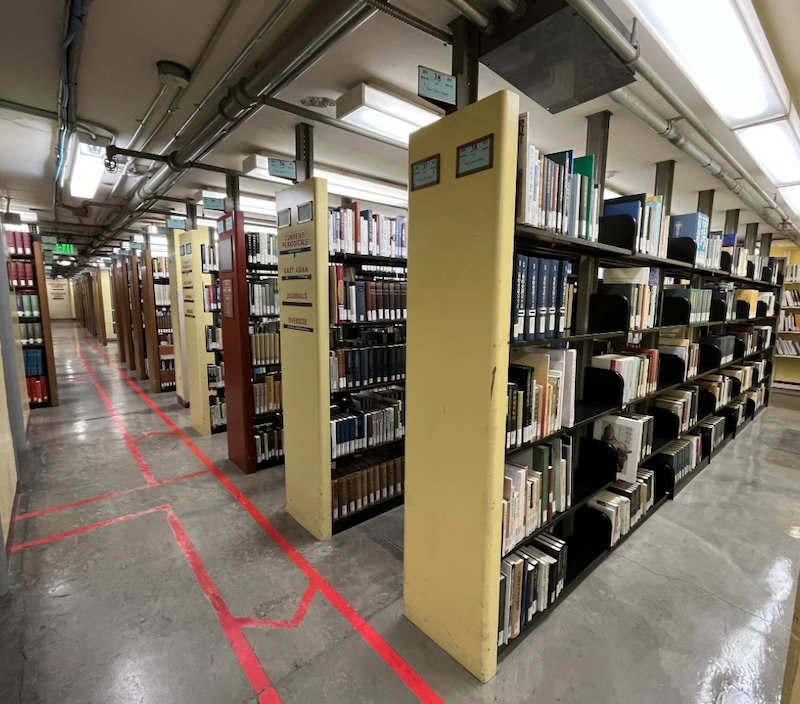
There are desks hidden throughout the 7 floors of book stacks!
Category Three: Miscellaneous
Many students don’t realize that when classes aren’t in session, you can use empty classrooms to get some work done. I especially like studying in the classrooms in Taper Hall and DMC. It’s a bit of a gamble, as you will get asked to leave if a class starts up, but it often works well in the afternoons or evenings when the buildings are quieter. There’s something nice about having a whole classroom to yourself to focus, spread out and bring a study group, or even practice a presentation.
The Tutor Campus Center (TCC) sits right in the heart of campus, next to the bookstore and the Tommy Trojan statue. The first floor is home to several popular lunch spots that accept dining dollars, as well as the Admissions Center. But the real hidden gem is upstairs — take the grand staircase (or the elevator) to the second floor, where you’ll find several student lounges. These spaces are sometimes reserved for events, but when they’re open, they make for a perfect mid-day study spot or a comfortable place to relax between classes.
Happy studying, Trojans! I wish you the best of luck!
⋯
Social
Facebook Instagram LinkedIn TikTok YouTube