



Student Blog
Second-year Students Are Here for You Too! ⟩
October 15, 2020, by Liz
The end of my second year as a master’s student seems so close, yet so far away. So exciting! I feel as though it was just yesterday that I moved out to Los Angeles and sat out on the CHP patio waiting for orientation to begin. As I reflect on how close I am to the end, I can’t help but think about all of the wonderful support I’ve received these past two years.
Something that is unique about our program is how willing our faculty is to support their students. Check out Calvin’s most recent blog post about finding faculty mentorship—he has some great tips! With everything going on and classes being held virtually I can imagine how difficult and intimidating it might be to reach out for mentorship at this time. Another good place to start is to reach out to students! I can say so from experience.
Last year I was seeking more than just attending class, studying for exams, and working on things I felt like I HAD to do. Fortunately enough, our very own Daniel Padilla made an announcement on our Facebook page regarding a program he and his colleague, Ceci, were leading together — Vivir Con Diabetes. In his announcement, he expressed his hopes of recruiting some student volunteers to help with his program. The program was designed to cater to the needs of the Spanish-speaking community of Boyle Heights, many of whom are low-income. The main goal was to improve the diabetes management of this population by improving their habits and routines, all while providing culturally sensitive interventions.
Immediately I was intrigued! This program was something that really hit home for me and a way in which I felt as though I could give back to my community. This is something that I am really passionate about. I immediately thought about my grandmother who always thought the best way for her to improve her diabetes management was by replacing regular coke with diet coke. Sounds silly, I know. But, she really believed this! I thought, if I could give back to the community in any way and work with people like my grandma I would. So, long story short — I volunteered. Now that Daniel and Ceci are onto bigger and better things, I am leading these sessions along with one of my best friends in the program, Stephanie.
I consider Daniel to be one of my mentors! Because I reached out to him due to my interest in this program, I’ve been able to take the lead on it this year. He also provided me with a lot of support as I applied for the OTD a few weeks ago by looking over my resume, practicing some interview tips with me, and in general has been nothing but great vibes! Daniel if you’re reading this, you’re awesome!
While applying for the OTD I also reached out to Marylin. I was nervous to do so given that she is now at her residency site, full of work and other responsibilities. But, she took the time after her long work day to also give me some feedback on my resume. I appreciated that so much! I thought, “Wow, even after a long day of work she still set aside an hour to help me out!”.
What I am trying to get at here is that students who are farther along in the program are also very willing to provide some support for you all. I can think of 7 off the top of my head: Savi, Calvin, Bethany, Yna, Lamoni, Daniel, and myself. If there’s any way in which we can support you, help you connect with faculty, and/or serve as mentors for you to grow while you’re here we are more than happy to do that. So, if you’re nervous to reach out — don’t be! Us second-year and alumni folks are so willing to help. With that said, please feel free to send me an email at any time to chat about school or anything in general!
⋯
Personal Statements: On My Way to the OTD ⟩
October 14, 2020, by Bethany
I just submitted my application to the OTD program! The applications for the USC Chan OTD Residencies have also just been submitted. It feels like I can take a breath now. I may not be done with the whole OTD process, but it’s nice to have gotten started. I had forgotten what it is like to have applications sitting over my head. But a few good personal statement tips, some even from applying to college as a high schooler, came to mind:
- Do Your Research — Know what each individual residency (or college, if that is the application stage that you are in) has to offer. Know which residencies will be the best fit for your skills, your interests, and your future goals. You want to find the sites that you can learn the most from and that you can contribute the most to.
- Tell a Story — The best part about applications is that these are not normal essays. Yes, you are still trying to prove a point: that you belong at this residency. But unlike your usual school essay, are not limited to third-person speech or to proving your point through quoting sources. You get to tell the story of you. So go wild! Find the experiences that you have lived that show that you have what they’re looking for.
- Ask for Help — Ask for input from friends, parents, student ambassadors offering help (Thank you, Daniel). They can be that extra spell-check, and they can also offer perspectives, ideas, and personal experiences you hadn’t thought of including.
- But Be Okay with Saying No — In the end, as much advice as you get, these are your essays. This is your chance to show who you are. If you get a suggestion that doesn’t flow with your writing style or doesn’t paint the picture you want it to, it’s okay to say no. (Do so nicely, though!)
- Chunk It — When you suddenly have writer’s block, it’s okay to take a break. Go get ice cream. Get away from a screen for a little bit. Have a conversation with someone; maybe some new ideas will come up. And even if they don’t, walking a way for a break can open up new perspectives when you decide to write again.
Once you’re done with the personal statements, celebrate! Bake some chocolate chip cookies and pet the dog. Then you can start thinking about the remainder of the application process, such as interviews and things. Daniel has additional advice about the application process. The process may have just begun, but give yourself a pat on the back. Step one is done!
⋯
Savi’s Electives Experiences ⟩
October 7, 2020, by Savi
Over the past two semesters, I have had the opportunity to choose between a variety of elective courses to take in order to dive deeper into the subject matter I am interested in and begin my journey from an OT generalist to specialist. As a second year in the Master’s program, students are given the chance to take 12-14 units of elective coursework so that they can begin to focus in an area of interest.
When I began this Master’s program I was extremely interested in taking the OT 561: Occupational Therapy in Acute Care elective, as I have always been interested in pursuing a career in acute care. Unfortunately, this elective was no longer offered this semester as they wanted to keep all students, faculty, and patients healthy and at a safe distance. Although this was sad news for me, this decision also allowed me to explore electives I wouldn’t have otherwise! Now looking back on my decisions and experiences I could not have imagined it any other way! I love all of my electives and have learned such valuable information that will help guide me in whatever practice setting I choose in the future. Here is a glimpse into my electives and why I chose them!
OT 574: Enhancing Motor Control for Occupation
This semester I was fortunate enough to have been randomly selected to take the Motor Control elective at the California Rehabilitation Institute. This course has opened my eyes to so many unique and fun things OTs can do in an inpatient rehabilitation setting. Before beginning this course I knew that I wanted to hopefully work as an OT in an inpatient rehabilitation or acute setting after graduation, but was worried I wouldn’t have experience working with patients in either of these settings. This course provided me with four hours of weekly clinical experience with patients guided by an assigned clinical instructor, as well as lecture material focused on providing tangible methods for remediation of motor control problems following upper motor neuron lesions. In lectures, we spent half the time learning the theories and concepts of motor control and motor learning, and then the other half applying our knowledge and skills in practice. Through this class, I learned how to complete scapular and trunk assessment, facilitation, and mobilization, shoulder subluxation positioning and taping, inhibitory casting, neuromuscular electrical stimulation, edema management, and much more! Check out the pictures at the bottom to see what these look like. I had a lot of fun working with patients and applying my knowledge in real-time with the assistance of experienced OTs.
OT 575: Dysphasia Across the Lifespan
As a food lover myself, I have always listed eating as my #1 favorite occupation. After working in a few pediatric settings and seeing how impactful OTs can be in the feeding process, I wanted to learn more about our impact across the lifespan. This course has provided me with an immense amount of knowledge regarding the various assessment and treatment strategies used for patients and caregivers. I have also gained a greater understanding of the oral, pharyngeal, and esophageal anatomical structures involved in swallowing and how they relate to normal and abnormal swallowing. On the last day of class we all received a large box of delicious snacks to eat and test out. This helped us gauge the sensory qualities, understand the effects chewing has on consistency and texture, and brainstorm fun activities with each snack option to engage our future clients.
OT 566: Healthcare Communication with Spanish-Speaking Clients
¡Hola! Mi nombre es Savi y yo soy su terapeuta ocupacional. I am extremely passionate about developing a comfortable and safe environment for all my clients. During my time completing observation hours in San Diego and fieldwork in Los Angeles, I have noticed that a large quantity of the patients and clients I have worked with are primarily Spanish speaking. Because of the language barrier, I felt as though I am not able to make them feel as comfortable as I could. I, therefore, wanted to take advantage of this opportunity to learn how to communicate in Spanish at an elementary level in a therapeutic context. By doing so I have learned how to say common OT phrases and terms in Spanish, to facilitate better connections and relationships with my future clients. Dr. Delgado has brought in OTs from a variety of settings to help us learn context-specific and cultural terms and phrases. Gracias, Profesor Delgado!
OT 564 Sensory Integration Theory
I decided to take sensory integration (SI) theory because I wanted to get a better understanding of the neuroscience backing and foundation for sensory integration. After completing the pediatrics immersion, I didn’t feel confident about the level of understanding I had regarding SI in comparison to other students I had spoken to in my cohort. This made me extremely nervous since SI is so important and prevalent in OT practice across all settings. I, therefore, wanted to get a better grasp on the neurobehavioral principles of Sensory Integration Theory before entering into my Level II fieldwork and eventually sitting for the NBCOT exam. This class did just that!
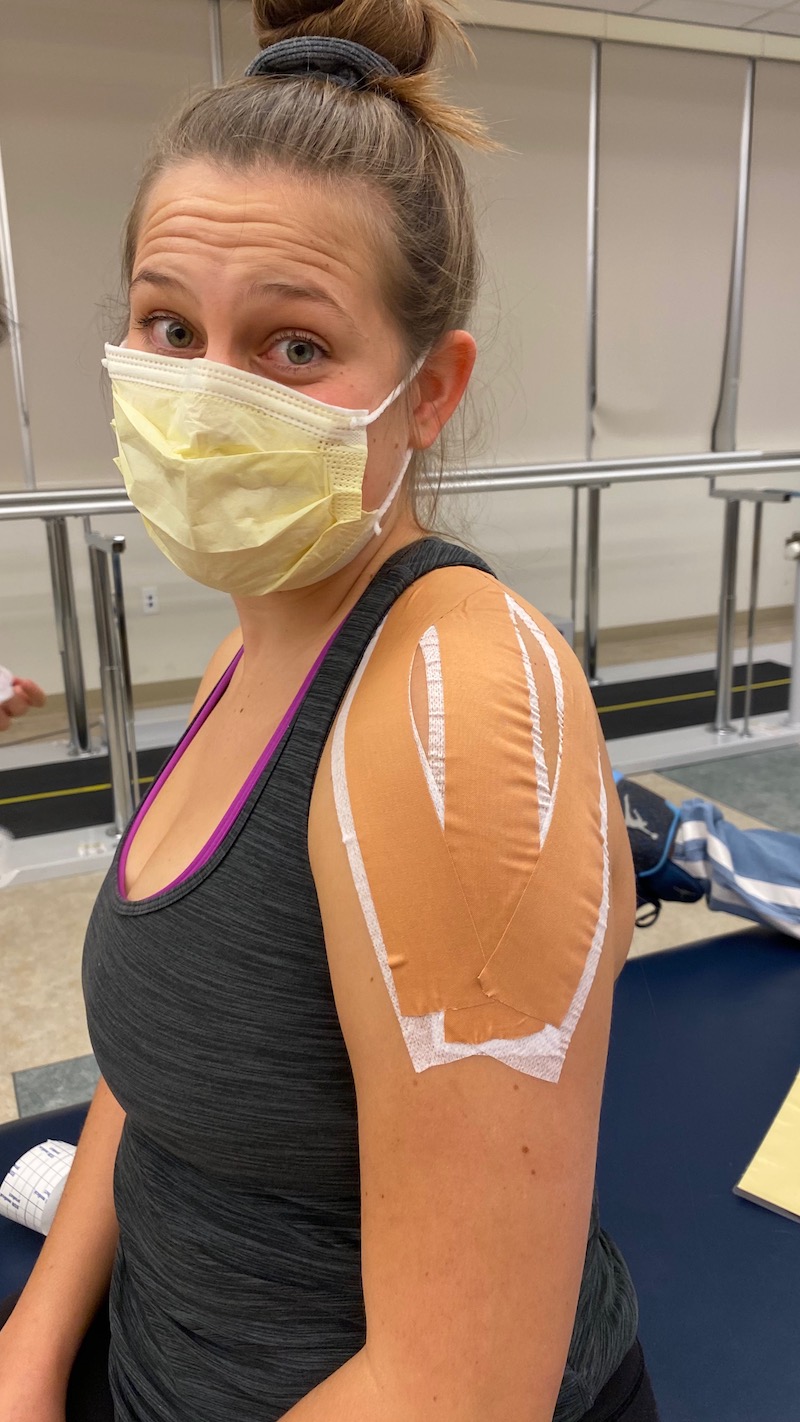
Showing off my shoulder taping, which is used to assist with realigning and supporting a shoulder joint with subluxation.
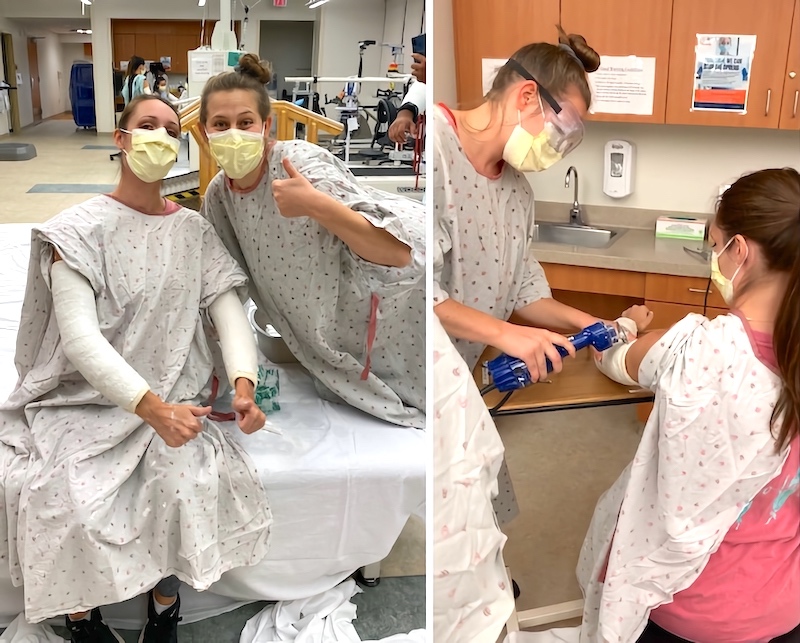
Practicing serial casting on classmate Alana Schoenhals to manage tone. We even got to saw off the cast we made!
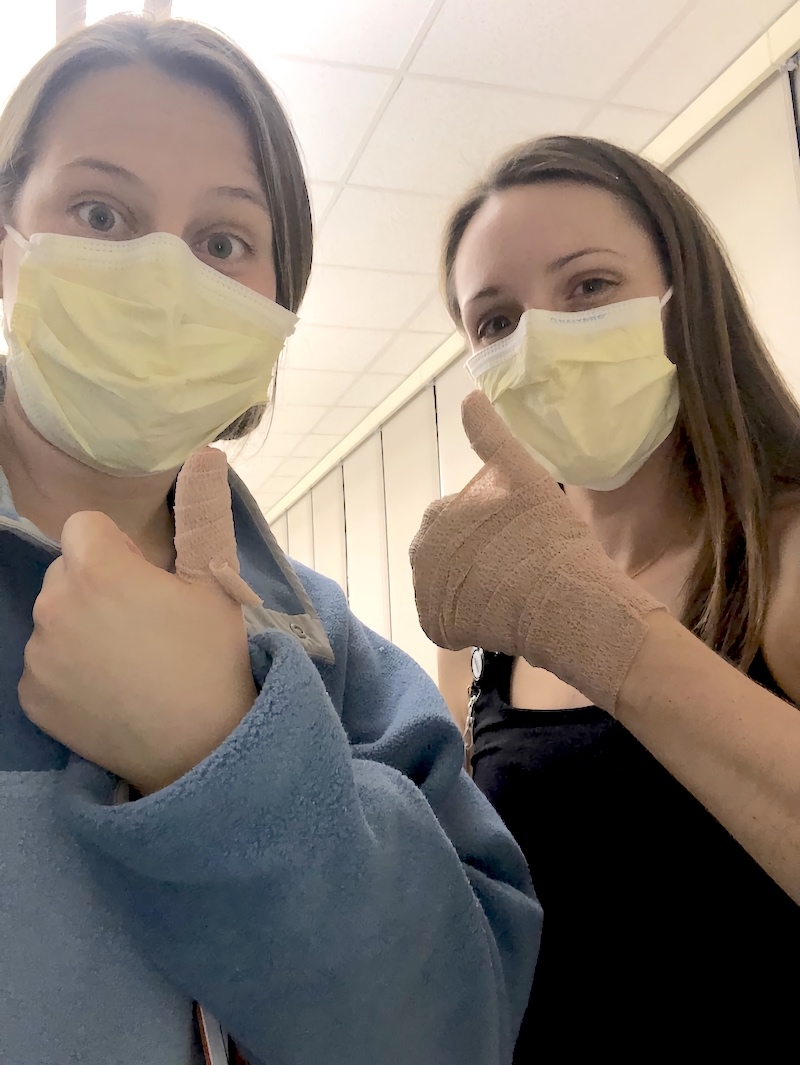
Classmate Alana Schoenhals and I showing off our compression bandage treatment after doing retrograde massage on one another for edema management.
⋯
Finding Faculty Mentorship ⟩
October 5, 2020, by Calvin
Having come from a large public university for my undergrad, I didn’t feel like it was as accessible to connect with professors and find that kind of professional mentorship. So once I got into this program, I was surprised to discover how available and how approachable the faculty truly are. There is an exceptional range of faculty and, although they may have a ton of things on their plate, I’ve found that something they all have in common is that their doors are always open to students.
However, while I am grateful to be able to call some of the faculty my mentors, I definitely remember how nerve-wracking it was to step outside of my comfort zone to reach out to them. Towards the beginning, I had these thoughts of, “should I only be talking to the professors that teach my classes?”, “what do I even say to them . . . .”, and “will it look like I’m kissing up?” I know that it feels like there’s a lot of pressure to fully use the resources available at USC Chan, so I want to share some information on how I established mentorship and some overall tips and advice for all of you trying to move forward in this process!
Trust in the process:
- I know that, even after hearing how friendly the faculty may be, they still might seem a little out of reach and maybe even scary to get in touch with, especially with those that don’t teach your courses. I felt the same way, and I would always think that I would be wasting their time if I asked to talk to them about their experiences, interests, life, etc. But speaking from experience of going through this process, just know that they’re here for you, they feel for you, and they really are open to being reached out to if you ever need anything.
They’ve been in your shoes before:
- Before, it had never occurred to me to think about how the faculty here were students too. Well, they were! Some of them are actually alumni of USC Chan, and so they know a thing or two about the classes we’ve taken, the practice areas we might be interested in, and the challenges we’ve gone through to get here. The faculty are people too, and they know what we’ve gone through and will go through, so don’t be afraid to get in contact with them because they might be able to relate and give you some pointers along the way.
Do your research:
- Go onto the Faculty Directory page and do some exploring! There’s also a dropdown menu that can guide you to a specific group of faculty. We have faculty that have a range of various experiences and expertise, so take some time looking over their biographies, research interests, and interests in general. You never know what you might be able to find! If someone doesn’t teach any of your classes, don’t let that stop you from reaching out to them. Maybe someone conducts research that you find fascinating or maybe someone is an alum from your previous school! Have fun with this experience because it’s like a little sneak-peek into each of the faculty here!
Just hit the send button:
- I remember when I was way too nervous to even send an email to them. I really just wanted to introduce myself, share why I’m interested in their work, and learn more about how they got to where they are. However, I was afraid of the chance that they might not respond or that they might be annoyed that I’m bothering them. But I realized that there is nothing to lose! If they don’t respond, then follow-up with them. Faculty get a mass amount of emails every day, so sometimes things get lost in the flood. If you think they’re not interested, then maybe it’s not a good fit or maybe you can ask to talk with them over a Zoom call/in-person (once we can do that again). Sometimes it’s hard to analyze someone’s attitude over an email and the faculty are busy people too. It might be that they don’t have time to respond or to write out a thorough email, so give them some time and check-in as needed.
Know what you want:
- What qualities are you looking for in a mentor? Do you want someone to help with your professional development? Do you want someone to just have chill conversations with? What about both? It’s okay if the first faculty that you interact with doesn’t automatically feel like a mentor for you. The process takes time! As much as you want to find the right fit, the faculty also want to see if you’re the right fit for them. So, before you reach out to someone, you should at least have some idea of who they are and what they do, as well as what you want out of the mentorship experience. This is so that you and the faculty can picture what the potential mentorship could look like. Also, with all that being said, you aren’t limited to just one faculty mentor; you are free to build these relationships with as many faculty as you want! Just continue to remind yourself why you’re searching for mentorship and be realistic with your expectations.
Benefits of mentorship:
- I’ve found that my faculty mentors have provided me with different, but strong benefits. Some provide me with affirmations to my skills, some are just nice to have casual conversations with, and some are really good at being real with me and keeping me in check! Having faculty mentors can serve as a resource in terms of networking opportunities and letters of recommendation. Mentorship can also come in all kinds of capacities ranging from consistent weekly/monthly check-ins or even just a few times a semester. As a mentee, I want to be able to provide mutual benefit by supporting my mentor and being there for them as well. I also want to pay this mentorship forward by continuing to support prospective students and current students. I’m super lucky to have been able to build this kind of relationship with some of the faculty here and it’s comforting to know that I can always reach out to these people, even after graduating from this program.
It kind of just happens:
- You’re probably wondering: “What’s the step-by-step process to establishing a mentor?”, and what I’ll say is that it’s pretty fluid. The program does set up an actual faculty advisor program by splitting up students into groups and placing them with one faculty advisor per group. The idea is that your faculty advisor may help you to identify and connect with faculty mentors throughout your relationship with them and they can direct you to other resources, as needed. In terms of seeking out a faculty mentor on your own, it’s not really like a “can you be my faculty mentor?” situation. It’s more so just getting in touch with faculty, gradually getting to know each other, sharing experiences, even working together on projects, and so on. I like to think of it as more of a friendship because it kind of just happens as you get to know and interact with them more and more!
Being in graduate school has really made me appreciate the tight-knit community and intimate interactions with faculty. I hope that this gives you some insight into how to get started in establishing faculty mentor relationships. I also hope that this makes the experience seem a little less scary! I tried to be as real as possible so that I could give you all the information that I wish I had when I was in this process. Feel free to reach out to me at .(JavaScript must be enabled to view this email address) if you need anything and good luck!
⋯
My first time on campus ⟩
October 2, 2020, by Yna
From the time I enrolled in my Master’s program at USC, one thing I had really been looking forward to was getting to visit the beautiful campus that I have only been seeing in pictures. Unfortunately, due to the pandemic and in efforts to socially distance, I have not been able to do this since most of our classes had to be held remotely. One of the courses I was enrolled in, however, entailed an on-campus lab class which gave me the opportunity to finally visit the campus for the first time!
If you’d like to see my experiences during my first time on campus and are curious about the safety protocols in place to keep the Trojan community safe and healthy, check out my video below!
[Credits to Elmo Nicolas for some of the video clips]
⋯
Social
Facebook Instagram LinkedIn TikTok YouTube