


Student Blog
What are OS/OT?
Tai Chi and (Chai) Tea ⟩
January 23, 2014, by Clarissa
Classes Community Diversity What are OS/OT?
This morning, I saw a group of older adults practicing Tai Chi in a park nearby my house and I felt so happy! Why, you ask? I took a class last semester geared towards creating a community project. My group members and I interviewed experts, talked to community members, and designed a program for (you guessed it) Tai Chi!
Older adults are often at risk for falls and social isolation. In our research regarding Tai Chi, we found evidence in the literature supporting Tai Chi’s positive effects on fall prevention in older adults — it helps with factors contributing to falls like balance, coordination, and fear of falling. To address fall risk and social isolation, we decided to write a proposal for creating a Tai Chi class followed by time to socialize with tea. The social relationships built through tea time could also motivate the older adults to join our class.
We decided our target population would be older adults in Monterey Park, a city just east of downtown LA. The city has a 66.9% Asian population. In our research, we also found that Asians were less likely to talk about their lifestyle to their health providers so they may have needs that aren’t being met. The cultural familiarity of Tai Chi (and the tea!) may work to encourage their attendance to our program.
To explain the title of this blog post — my group really wanted to name our project Tai Chi and Chai Tea but had to very sadly let go of it. Chai tea’s sugar content may not be the best for older adults. The title lives on here. Woohoo!
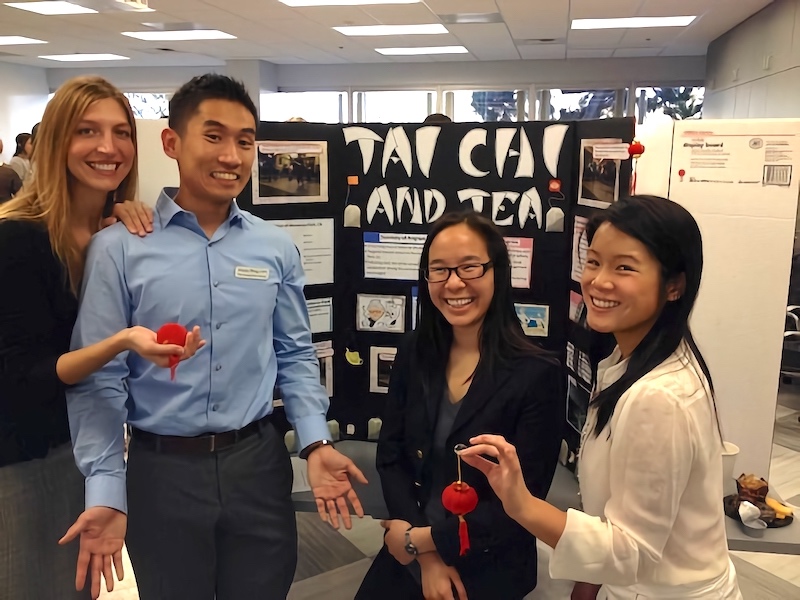
Here’s a picture of me and my awesome group on poster presentation day!
⋯
Learning More About Occupational Science ⟩
January 23, 2014, by Kate
What are OS/OT?
Sometimes it’s difficult to find other people who know what occupational therapy is, but think about the mystery that is occupational SCIENCE. People look at me like I’ve misspoke when I tell them more about our Division at USC and the classes I am currently taking. “Occupational science? What is that? Do you use microscopes and test tubes?” Not exactly. We have been introduced to the concept of occupational science since our first semester, but now as second-year students, we are all taking a Seminar in Occupational Science 2-unit course. Today I will be attending my second class of the semester, and the experience thus far has been really interesting!
From what I know, the concept of occupational science was actually founded at the University of Southern California in the 1980s when the university offered PhD degrees in the field for the first time. It’s crazy to think that our school has been such a leader in our profession!! Occupational science can roughly be defined as the study of human activities (occupations) and how participation and engagement in these activities impacts our lives. This class is really helping to bring all the concepts we have learned over 2 years into full circle.
⋯
A Day with Celebrities ⟩
November 21, 2013, by Clarissa
Getting Involved What are OS/OT?
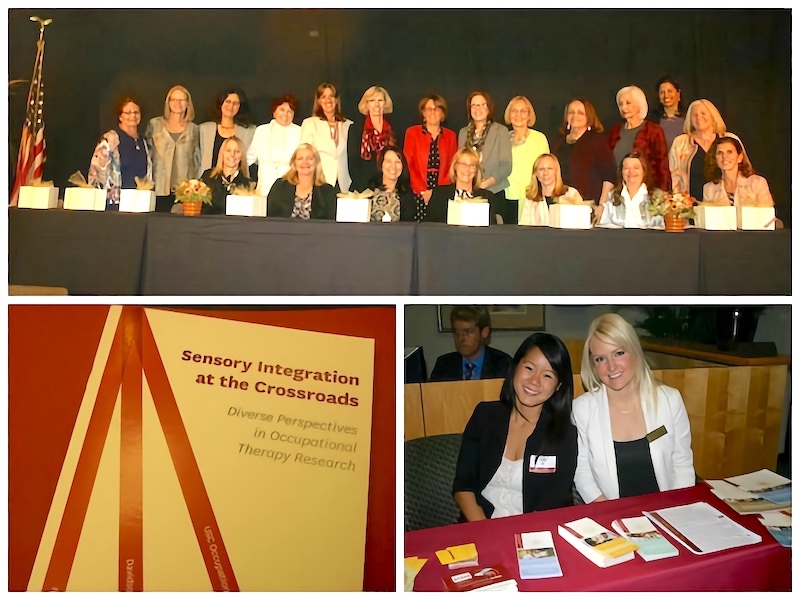
Life at the USC OS/OT Division has been really eventful and exciting. So many things happening to update you on! It was hard but I am picking the 24th annual Occupational Science and Occupational Therapy Symposium at USC occurred a couple of week ago to hone in on today. This year, the symposium focused on research on Sensory Integration (SI), which is a specialty practice area of occupational therapy. SI theory is the manner in which one’s neurological system organizes sensation from the environment for participation in occupations. Dr. Jane Ayres, who was actually a faculty member at USC, developed SI theory!
I’m currently learning about SI in my pediatrics immersion and see it practiced in my fieldwork — it was really great listening to what the big names in SI and pediatrics had to say about it based on their research. Presenters included Drs. Jane Case-Smith, who wrote our pediatrics textbook, Lucy Miller, who created an assessment tool (Miller Function and Participation Scales) that we learned about in class, my neuroscience professor Barbara Thompson, and the chair of our division, Florence Clark. It was so cool seeing and learning from the people whose tools we use in school and practice! It really hit home just how renowned the presenters, which included USC faculty, are and how lucky I am to attend such an amazing school where opportunities like these to learn are readily available. Practitioners in the audience were snapping pictures of the panelists — they are celebrities!
Here is my very own paparazzi shot of the presenters and also a photo of me and my fellow student ambassador Kate! I’d take breaks from my part-time job title of “paparazzo” (yes, I had to Google the singular form of paparazzi) to visit her.
⋯
Class Project ⟩
November 18, 2013, by Ryan
Classes What are OS/OT?
I recently had to interview an older adult (65+) and write a paper about their changes in roles, responsibilities, and occupations. I interviewed Walter (fake name for privacy purposes) who is actually my dad. In order for me to fit in this interview, I chose to interview my father and I know very little people over 65 years old. My grandparents have all passed away; I have a great-aunt and 2 friends but could not coordinate schedules . . . so it ended up being my 66 ¾ year old dad. And I am so glad it worked out this way. I did not grow up with my father and have built a relationship with him as an adult so I enjoyed sharing this time with him. I also don’t get to see him that often and I learned a lot about his past.
I don’t think he really understood that I was interested in his activities/occupations but he shared a lot about his views and interests throughout his life. He was very politically involved and had interest in the Black Panthers which was very surprising to me. I have rarely seen my dad mad, or even mean to a single person. He is the sweetest, fun loving guy and I could not see him relating to violence. He explained that he grew up in Los Angeles in the 1960s and ‘70s, around gangs and violence so that was all he knew. He even expressed that he never thought he would have lived as long as he has. As we continued to talk about the activities he has transitioned to now I noticed a shift in the way he looks at his life. When my dad was young he was a bit more selfish in his thinking about did not think of the future. Now his main activity is working to support his family and prepare himself for retirement in the next year. Also within the last couple years, he has changed to eat healthier food and has expressed wanting to be more involved with his family, especially his grandkids.
I think my dad has become wiser in his older age and he agrees. He no longer feels he is self-destructive; he just wants to make people laugh and help his family. This interview was such a great gift. I really enjoyed seeing another side of my dad and I think I will try to do a few more recorded interviews for myself to keep. I appreciate his positive attitude about aging and I hope to help others see the value in finding meaning throughout your life if I work with older adults. I also will take this information with me as I get older and hope to age as gracefully as my dad.
⋯
Happy Veteran’s Day! ⟩
November 12, 2013, by Ryan
Getting Involved What are OS/OT?
I was able to help out as a Student Ambassador at the Veteran’s Appreciation Reception dinner last night. I helped set up and took photographs to document this great event. I wanted to attend this event because my grandfather and father served in the army, my grandmother was a women’s marine, and my uncle was in the navy. I have a connection to people who have served and think it is a great idea to show our appreciation. Also, being in the master’s program I have learned about the many ways we can support this population through occupational therapy. And what an awesome way to spend Veteran’s Day!
The reception dinner was held at the Town and Gown building on the University Park Campus, a beautiful dining hall with amazing chandeliers in an old brick building. As I walked around taking pictures I would talk to individuals who have served or are connected to the population in some way. There was a woman I met who is in the social work program and wants to work with veterans when she graduates. Her brothers, father, and uncles have all served in the army so this population is close to her heart and you can tell by talking with her. She expressed such passion for veterans and talked about going to meetings for veterans to start building connections before graduating. She actually gave me her contact information once she found out I was in the OT program so if the opportunity presented itself, we could collaborate in some way to help out this population.
I also met a man that had a service dog. He explained that once he returned from service, he had so much anger and would seek out violence. He would go out to bars wanting to pick fights and started carrying a gun illegally. He was going to therapy and making progress, but couldn’t shake the desire to be violent. He became connected to Pets for Vets and expressed that he need help or was going to buy another gun. They provided him with a stray dog and it changed his life. The process of caring for an animal, having someone that counted on him, someone to come home to, he lost the desire for violence. Isn’t that amazing!
This event was great and opened my eyes to the many young veterans coming home and needing support. I am so glad that OT is so broad and able to help this population. For those out there interested in OT and veterans, know that there is so much we can do. OTs look at the whole person and that is exactly what vets need, from psychosocial to biomechanical. Yay, OT!
⋯
Social
Facebook Instagram LinkedIn TikTok YouTube