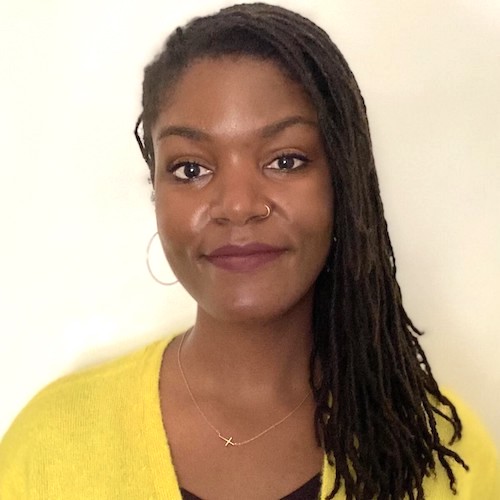
Candace Chatman OTD, OTR/L (she/her/hers)
Academic Fieldwork Coordinator (Pediatrics) and Assistant Professor of Clinical Occupational Therapy
CHP 133
.(JavaScript must be enabled to view this email address)
Dr. Candace Chatman is an Assistant Professor of Clinical Occupational Therapy and Academic Fieldwork Coordinator for Pediatrics. Her dedication to improving the lives of families and children with disabilities began with a Master’s in Teaching Special Education from Loyola Marymount University, a Master’s of Science degree in occupational therapy from California State Dominguez Hills, and her Doctorate of Occupational Therapy degree from USC. She is passionate about pediatrics, mental health, and advocacy. She is currently the Treasurer of the Occupational Therapy Association of California.
Education
Doctorate of Occupational Therapy (OTD)
2020 | University of Southern California
Master of Science (MS)
in Occupational Therapy
2016 | California State University Dominguez Hills
Master of Teaching (MAT)
in Special Education
2006 | Loyola Marymount University
Bachelor of Arts (BA)
in English Literature
2003 | Seattle University
Selected Publications
Ausderau, K. K., & Chatman, C. (2023). Evaluating playfulness in children. In E. A. Pyatak & E. S. Lee (Eds.), 50 studies every occupational therapist should know (pp. 235-240). Oxford, UK: Oxford University Press. https://doi.org/10.1093/med/9780197630402.003.0034 Show abstract
The purpose of this study was to examine the reliability and validity of the Test of Playfulness (ToP) with children with physical disabilities and no known cognitive limitations, compare their scores with those of able-bodied peers, and examine patterns of difference in test items. Data from all of the children in the normative data set meeting inclusion criteria (n = 25) were paired with those from able-bodied children matched on gender and age. Data were gathered during two 15-minute videotaped free-play sessions. Rasch analysis revealed 100% rater reliability, and 88% of the children with physical disabilities conformed to playfulness patterns represented in the normative data. Mean ToP scores did not differ between groups. Based on the study results, the ToP is a highly reliable assessment for children with physical disabilities. However, person-response validity did not achieve 95%. Further investigation is needed to determine ToP validity for children with physical disabilities and environmental influences on playfulness.
Keywords. physical disability, play, assessment, Rasch analysis, reliability, validity, occupational therapy
⋯



Social
Facebook Instagram LinkedIn TikTok YouTube