



Student Blog
The Building Blocks of the Pre-Master’s Program ⟩
February 14, 2020, by Japeth
Admissions Diversity International Videos
Coming from a country where English language is not the official language may be difficult for some students who intend to go abroad for continuing education. This is what I also felt when I was still applying to the program. Questions such as “Will I be able to speak confidently?” or “Can I express myself and my thoughts properly?” were always on my mind. International students also need to take an English Proficiency Exam (IELTS or TOEFL) and must reach a score that is accepted by the department. This requirement is difficult, to be honest! Aside from this, students who are planning to enter graduate school must also take the Graduate Record Exam (GRE), which includes questions about analytical writing, verbal reasoning, and quantitative reasoning. This exam is just equally difficult, if not more, as the IELTS or TOEFL.
For interested international students who might be worried on their performance on these tests, don’t fret! I am happy to share about USC’s Pre-Master’s Program, which aims to help students improve their performance and scores!
Below is a video featuring Yen Ting Ni and Yi Fan Lin, both went through the Pre-Master’s program before joining this year’s Post-Professional MA in OT cohort.
I hope this video is helpful to future applicants and students! Also, I would like to share with you about what changes the Admissions Team has been doing! The admissions team headed by Dr. Arameh Anvarizadeh, together with Dr. Kristin Nxumalo and Dr. Amber Bennett, has changed how admissions look like! USC Chan has moved towards what we call the “new admission holistic process”, where all components of the admission criteria are given equal importance and value.
Fight On!
⋯
ASBME Makeathon: USC interdisciplinary collaboration ⟩
February 13, 2020, by Kevin
This past weekend, I had the opportunity to attend the Associated Students of Biomedical Engineering (ASBME) Makeathon event as an occupational therapy mentor. The Makeathon is an energy-charge 30 hour hackathon event in which 12 teams compete to develop and prototype a medical device for a selected real-world population. Using a combination of programing, CAD design, and access to the USC fabrication lab, including the 3D printers, each team rapidly develops an innovative medical or therapeutic technology. A Makeathon or hackathon challenges teams to produce months worth of work in just several days, in addition to having the material constraint of using only the materials provided by ASBME. While this event is primarily for students in the USC Viterbi Biomedical Engineering program, the organizers took an interdisciplinary approach by incorporating mentors from the master’s and doctorate programs of the Chan Division of Occupational Science and Occupational Therapy and the Division of Biokinesiology and Physical Therapy.
This year, the teams were challenged to develop a rehabilitation device that promoted or enhanced physical therapy activity in a nonclinical setting for persons who are experiencing hand or wrist dysfunction post-stroke. Additionally, the device had to be intuitive and address one aspect of motor control including strength, dexterity, and joint extension. Due to my background in 3D modeling and education in occupational therapy, I jumped on the opportunity to take part in the Makeathon as a mentor for the teams.
From the perspective of occupational therapy, the OT students were able to provide valuable advice and suggestions to each team considering person, environment, and occupational of the potential user. During my mentorship time, I performed role plays to help the teams imagine the device in everyday use, provided anatomical explanations pertaining to post-stroke hand and wrist considerations, and advised on design aspects. The undergraduate biomedical engineering students were incredible! I’ve never seen such fast CAD design or Arduino programming. While the students were working furiously to produce their device, they took time to seek out the mentorship of the OT and PT students, which helped the teams understand the rehabilitation applications of their designs. Everything from electronic glove games to dexterity puzzles were made during the course of the competition.
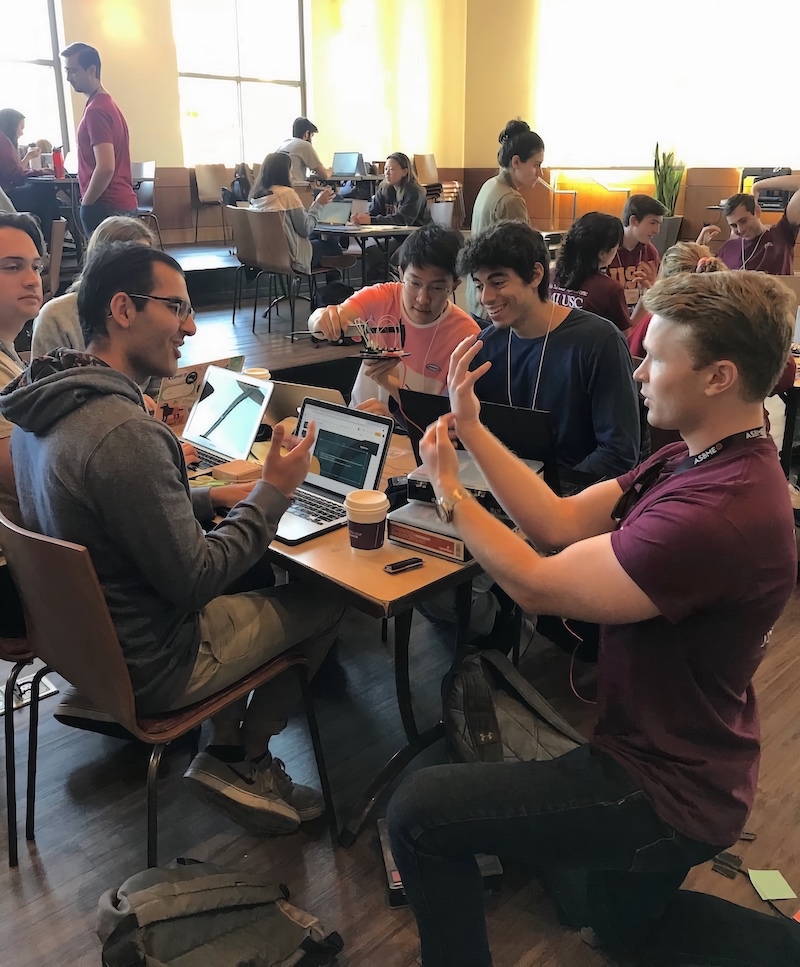
Explaining the extensor anatomy of the wrist and hand during mentorship.
Overall, it was amazing to see biomedical engineering, physical therapy, and occupational therapy students collaborating effectively to inspire truly creative innovation. Attending this event was a subtle reminder to the amazing minds and talent of the students at USC!
⋯

9 to 5? Working in Grad School ⟩
February 10, 2020, by Noelle
Life Hacks Living in LA School/Life Balance
Whether you are looking to earn a little spending money or pay next month’s rent, having a part-time job in grad school is definitely a possibility and reality for students here at Chan. On top of managing their coursework, I know babysitters, bartenders, and tutors, people who teach tennis lessons, pick up ride-sharers on their daily commute, and run their own businesses (check out Kevin’s side hustle if you haven’t already). Amazing right?!
As for me, I was a waitress during my first year and now work as a student ambassador. I remember applying for the waitressing job back in September 2018, nervous about having never held a tray in my life before, but more so, unsure of how I was going to maintain both a job and school. My only prior work experience was a low key student worker position that fit nicely into my flexible undergrad schedule, so I felt way in over my head just a couple weeks into grad school.
I was hired and started right as my first level one fieldwork began (great timing I know 😬). It was definitely a challenge at first to find a reasonable schedule and really, to learn how to be a waitress from scratch. But once I started getting into the groove (stopped spilling drinks and forgetting orders), it got way easier and dare I say fun? I worked on the school nights before fieldwork (because no homework was due the next day), weekends, and picked up extra shifts if it was a slower week at school. It was helpful that the restaurant was close to home/shuttle stop and my employers were pretty flexible about my schedule.
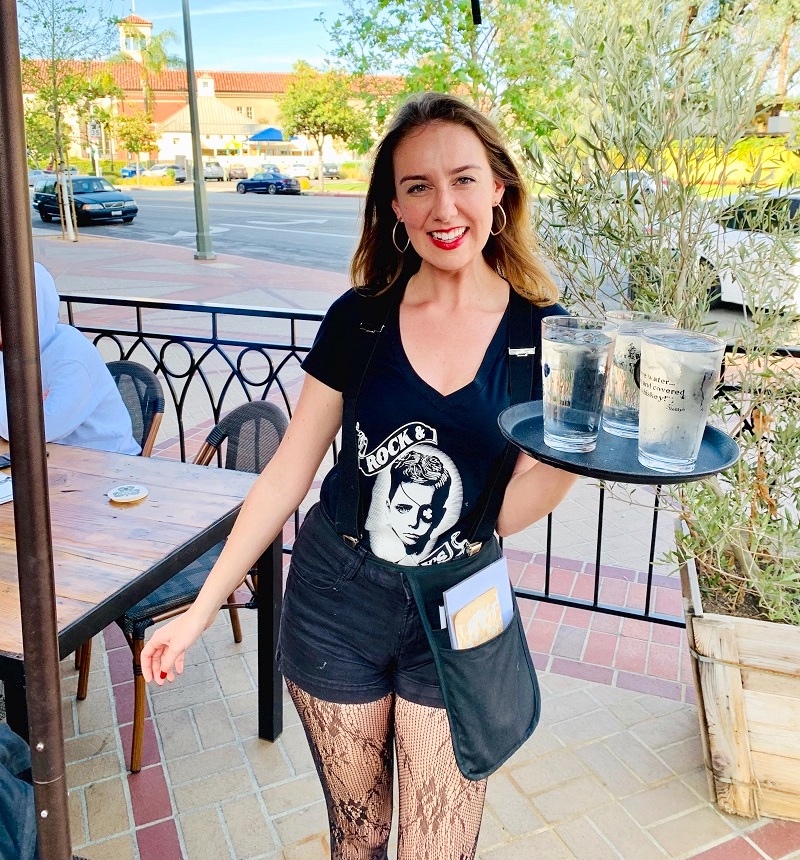
Taken on my last day of work . . . doing my best not to spill!
And I LOVED it. It was a great fit for my personality, gave me a little break from my student identity, and provided a whole different education and skill set. Second to my Level II fieldwork, it is my most prized bullet point on my résumé. It wasn’t all peaches and cream though. There were lots of late nights, crammed weekends, missed events, and several moments I had to remind myself that school was the priority. But I am so glad to have done it . . . and not just for the tips!
Of course, working during grad school looks very different from person to person. And my experience is just one example of how to make it work.
For this week’s song rec, let’s throw it back to 1973 with “For the Love of Money” by the O’Jays, a song I would frequently blast on my way home after a long day at the restaurant.
⋯

What’s a Student Ambassador? ⟩
February 10, 2020, by Kaho
Tis the exciting season of student ambassador application and interviews for the 2020-2021 academic year! In that spirit, I thought I’d share a little bit about what I do and what I’ve enjoyed while fulfilling my role as one of this year’s student ambassadors. There are several responsibilities that are shared among the entire team and some that I am specifically responsible for.
Shared
- Blogs
All of the student ambassadors take turns writing and posting blogs, such as this one. We’re free to write about anything, as long as it’s appropriate. I was nervous at first because I don’t consider myself a writer, but it’s a really fun way to share your thoughts/experiences and get creative while you’re at it. Some ambassadors have shared blogs in the form of videos, pictures, interviews, etc. It’s also exciting when friends, family, or even strangers tell you that they read and enjoyed one of your blogs. 😊 - Tours
We’re assigned to give tours to prospective students depending on who is in the office when needed. Usually, we take the students to the main campus (UPC) and tour them around the Division’s Center for Occupation and Lifestyle Redesign and OT House, and then tour them around the Health Sciences Campus. I love getting to know different prospective students, hearing about their passion, and getting to share my experiences as a USC student too. I also enjoyed learning about the Chan Division’s history in order to prepare for the tours. I now have random interesting facts about USC stored in my back pocket if I ever need a topic for conversation. - Info Sessions / Big Events
If you’ve ever signed up for an info session, you most likely met a student ambassador sitting in on the session. We get to chime in about what each course in the MA2 program covers, our experiences, and student life. This is another opportunity to meet all kinds of prospective students. At big events where a lot of helping hands are needed, we all work, like the admitted students reception and white coat ceremony. Though it’s a busy day, it’s exciting and fun to be working with the whole team. I love the feeling I get after finishing a successful event and sharing it with everyone. - Answering emails
Throughout the year, we get various emails with questions regarding the application process, program overview, events, etc. Everyone checks the student ambassador email account when they come into the office to work and answer those emails or refer them to someone that can.
Specific
- Managing Social Media
I collaborate with Kim Kho (AKA our boss) weekly to come up with content to share to our social media platforms. We look up national and international holidays, month-long observances, and relevant events happening around the Division and USC. The idea is to feature students and faculty of the Division to inform the general public of what’s happening in our program. I’ve loved being able to stay up-to-date with all that’s happening at USC Chan and interviewing various students and faculty about the amazing things they’re doing. It’s also super interesting to analyze the data from social media, like who are our viewers, how many interactions are we getting per post, etc. I wasn’t a huge social media person before getting this position, but I’ve learned so much about advertising, taking the right picture, coming up with captions, and the internet in general and I’ve really enjoyed all my tasks. (Follow us on instagram! @uscchanosot) - Meet the Trojan Family
Every Tuesday, we feature a student from our OS minor, bachelors to master’s, MA1, MA2, OTD, or PhD programs to celebrate the diversity in talents and backgrounds of the students. I collect the students’ submissions and make sure the post goes up on our website on time. (If you’re interested in being featured, email me at .(JavaScript must be enabled to view this email address) 😉 )
I love being a student ambassador because I get to learn more about the program, see the hard-work that goes on behind the scenes to improve our program and admissions process, and I get to share about and advocate for our profession. It’s made me a better communicator and public speaker, polished my time-management skills, sharpened my leadership skills, and introduced me to the best ambassadors team a girl could ask for. I’m super thankful that I had the opportunity this year to help represent the Chan Division and I’m looking forward to welcoming in the new team for next year!
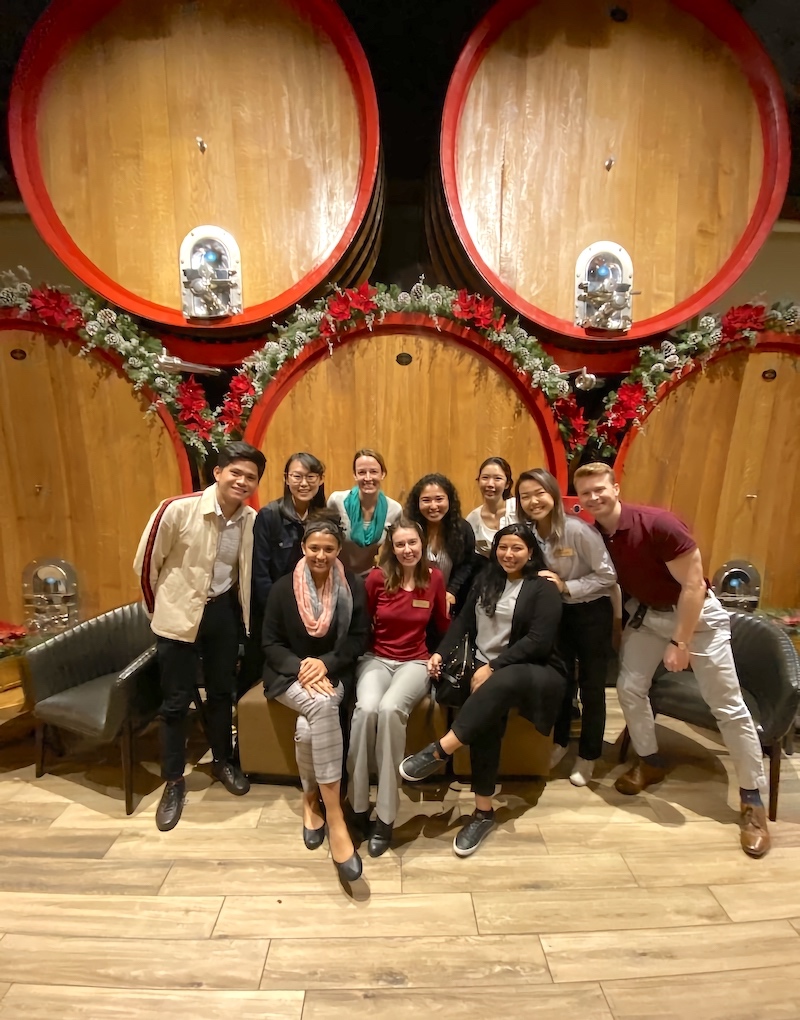
Ambassadors Team of 2019-2020
⋯
I was running (Forrest Gump voice*) ⟩
February 7, 2020, by Kat
50 minutes of running? Wild right?! Just 3 months ago, I would have laughed that I could have ran for this long. Balancing school, work, a social life, and self-care can be mad difficult at times. There is always readings to do, emails to send, and people to text. But I have recently found that running helps clear my mind. Running helps keep me sane and active. I feel accomplished when I make time to run because I feel like I am managing my time well, I feel more confident in my ability to take care of my body, and I feel empowered when I do something for ME! Before starting my running journey, I had no idea how much stress I carried in my body, both mentally and physically. On my runs, especially the long runs, it is just me, my thoughts, and my music. Eminem said it best, “You better lose yourself in the music, the moment, you better never let it go”. I do get lost in the music and the moment during my runs. Everyone needs a way to release and relieve stress. Running is my way. Staying organized, working ahead on assignments, and prioritizing my responsibilities helps me take care of me. When I run, it means I am taking care of all of these things. It is easy to get lost in the sauce of grad school. Don’t be afraid to try out new activities and explore what helps keep your well-being balanced. I had no interest in running growing up. Now I am up to 5 mile runs and love it. Almost to Forrest Gump status. Time to catch these miles!
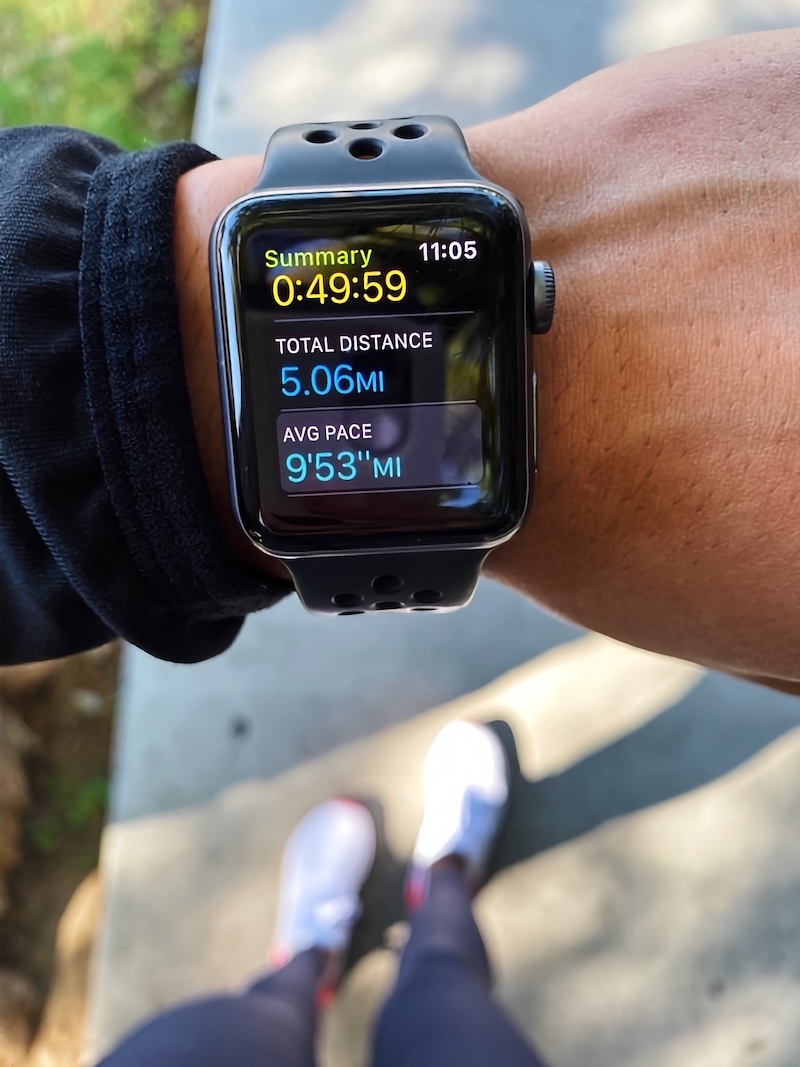
I found my Zen after this run yesterday!
⋯
Social
Facebook Instagram LinkedIn TikTok YouTube