




Student Blog
Living in LA

An International Student’s Guide to Learning to Drive in Los Angeles ⟩
March 20, 2026, by Angel
Housing and Transportation International Life Hacks Living in LA
For many international students, relocating to Los Angeles means navigating far more than a new academic environment. It involves adjusting to a vast city shaped by freeways, long distances, and a culture where mobility is closely tied to independence. Among the many transitions we face, learning to drive often becomes one of the most defining milestones because it gradually transforms into a symbol of confidence and belonging.
For many students, the journey toward becoming comfortable behind the wheel reflects a deeper experience. It blends uncertainty, determination, and the satisfaction of mastering something that once felt intimidating, sometimes while gripping the steering wheel a little too tightly.

The DMV: A Rite of Passage
The first step in this journey is often the most intimidating. The DMV is known for its long lines, complex requirements, and unpredictable outcomes. For international students, the experience can feel even more daunting because it requires navigating documentation, identification rules, and procedures that differ significantly from those in our home countries.
Yet this stage also becomes a point of connection. Standing in line with other students, comparing paperwork, and exchanging stories turns the DMV into a shared rite of passage. It is the one place where everyone silently agrees that we have no idea what is happening, but we are all trying our best.
Luckily, we need all the convenience we can get, and several DMV locations are conveniently close to USC Chan, which means students can get to their appointments and practice sessions without feeling like they are embarking on a cross‑county expedition.

Developing Skill Through Consistent Practice
Driving in Los Angeles presents its own unique challenges. The city’s fast paced freeways, complex intersections, and dense traffic patterns require patience, repetition, and a willingness to learn through trial and error. Many students find themselves practicing in the same neighborhoods repeatedly, gradually becoming more comfortable with the rhythm of the roads, and occasionally discovering a new café purely because they missed a turn.
Working with instructors further strengthens this foundation. Their calm presence and structured guidance help students refine technique, correct unsafe habits, and build confidence. A particularly effective strategy is narrating each action aloud, a method that reinforces awareness and demonstrates intentionality. It may feel awkward at first, but saying “checking mirrors” out loud is surprisingly grounding, even if your instructor already knows you have mirrors.

The Moment of Passing
Receiving a passing score on the driving test is more than an official achievement. It represents resilience, adaptation, and the ability to navigate a system that once felt overwhelming. Whether the test resulted in three errors or ten, the outcome is the same. Students gain a new sense of independence and a tangible reminder that growth often happens in unfamiliar territory.
For many, the celebration is simple. It is a drive thru meal enjoyed alone or shared with friends after the test. Sometimes the victory meal is joyful, sometimes it is reflective, and sometimes it is simply because the adrenaline crash makes you hungry.


Practical Tips for International Students Learning to Drive
Learning to drive comes with plenty of humor and unpredictability, but a few practical strategies can make the process much easier:
- Practice near your DMV. Test routes are often located within the same neighborhood.
- Narrate your actions while driving. Statements such as “checking mirrors” or “slowing down” help maintain focus and demonstrate awareness.
- Review traffic signs thoroughly. Pay attention to uncommon or situational signs that may appear during the test. For example, keep an eye out for the ‘No Left Turn Between 3 and 7 PM Except Sundays’ sign, which feels like it was designed specifically to test your problem‑solving skills.
- Approach four way stops with confidence. The first vehicle to stop proceeds first, and hesitation can create confusion.
- Match freeway speeds when merging. This ensures smoother transitions and safer entry onto high speed roads.
- Bring all required documents and extras. Unexpected requests are common, and additional documentation can prevent delays.
- Stay calm. The driving test evaluates safety rather than perfection. Even seasoned drivers occasionally forget which way to turn their wheels on a hill.

Why This Milestone Matters
Learning to drive in Los Angeles is not merely about transportation. For international students, it is a testament to adaptability, courage, and the willingness to step into discomfort. It reflects the broader journey of building a life far from home, one filled with challenges, small victories, and moments of unexpected pride.
At USC Chan, we often talk about growth as something that happens through meaningful engagement, supportive communities, and experiences that stretch us. Learning to drive becomes one of those moments. If we can navigate the DMV, the 405 freeway, and our own nerves, then we can navigate the academic, cultural, and personal challenges that come with studying at USC Chan. This milestone reminds us that independence is built gradually through persistence and community support.
Here is to safe drives, late night snack runs, spontaneous road trips, and the confidence that comes from mastering something new. Here is to every international student learning to thrive in a new city, one skill at a time!

For students who would like additional guidance on obtaining a California driver’s license, USC’s Office of International Services provides a clear overview of requirements and procedures. You can find the full details here.
⋯

My Sponsored Weekend Trip to Catalina Island Care of USC ESA ⟩
December 19, 2025, by Makayla
Community Getting Involved Living in LA School/Life Balance
One of the amazing perks of being a USC student is the numerous free experiences that we can take advantage of throughout the school year. This semester, the USC Environmental Student Assembly (ESA) hosted its annual, fully funded, overnight trip to the USC Wrigley Institute for Environmental Science on Catalina Island. This free opportunity was one that I simply could not pass up, and I was lucky enough to be able to join their program. Especially during these stressful times in the middle of the semester that are filled with the never-ending stress of deadlines and midterms, having the opportunity to engage in nature-based occupations is essential. In doing so, participating in restorative and rejuvenating practices contributes to our sense of self and occupational awareness, not only for our overall well-being but also for our school performance.

We made it to the USC Wrigley Institute!
During my trip, I was able to stay at USC’s own, one-of-a-kind satellite campus at the Wrigley Marine Science Center on Catalina Island, with free room and board included. It is an active research facility and living lab where students and researchers uniquely investigate environmental and sustainability initiatives while immersing themselves in the pristine natural environment on Catalina Island. Here, I embarked on a weekend trip that I won’t forget, where we hiked through scenic views, snorkeled in the deep waters of rich marine life, kayaked across the rushing waves, and learned invaluable research from current students and USC researchers alike.
Saturday
6:45 AM
My friend and I loaded our duffel bags into the charter bus bright and early, excited to head to Catalina Island. First, we drove down to San Pedro to go to the Southern California Marine Institute, where our boat, Miss Christi, was docked. After some pictures and a safety briefing, we were on our way to the USC Wrigley Institute by 8:00 AM. While it was chilly in the morning, my friends and I sat on the boat’s deck to enjoy the fresh air and take in the vast sea around us

The Miss Christi boat

Off at sea!

Gorgeous views from the boat’s deck

USC Wrigley Institute
10:00 AM
We arrived at the USC Wrigley Institute and loaded into the campus. We had a trip briefing and mandatory campus orientation before we checked out our rooms and got ready for our first activity of the day. I learned so much about the rich history of the campus and local ecosystems, as well as their sustainability efforts, experiential learning programs, and research initiatives that advance meaningful work in helping our planet. The rooms were very spacious, just like a normal dorm on campus, but what was neat was that they also provided towels, blankets, and pillows.

Hiking with my friend

Stunning views on the top of Catalina Island
10:30 AM - Self-Guided Hike
My first activity of the day was a self-guided hike on Deer Valley Loop Trail with my group, where we were able to hike through the lush greenery and take in the scenic views of the ocean and the USC Wrigley centers. This hike was definitely not the easiest at the start, with winding paths of uneven terrain and prickly pear cacti, especially in the hot weather. However, it was definitely worthwhile, as it was a great way to start the day and get some exercise in. Along the footpath we were able to spot a deer on the way down! Then at 12PM, we had a tight window to eat some lunch and head to the next excursion.

A deer spotted on the Deer Valley Loop Trail

Hiking through the Deer Valley Loop Trail
1:00 - Snorkeling
Next, we went snorkeling in the Blue Cavern Marine Protected Area, home to California’s richest marine habitats. We suited up in our provided wetsuits, fins, and snorkeling gear, and we were well on our way. While snorkeling in the deep waters of the channel, I saw so many Garibaldi fish perusing the rocky reef kelp forest and graceful eelgrass swaying by the ocean’s currents. Gazing into the Garibaldi fishes’ eyes, it was cool to knowing that they see me as much as I see them. As I traveled further, I saw a Halibut on the reef’s sandy bottom and many marine mammals and seabirds in the distance. This was such an awesome experience, especially being able to interact with the marine life up close.

My friend and I gearing up in our wetsuits

Post-Snorkeling: Tired but worthwhile!
3:00 - Hyperbaric Chamber Tour
After snorkeling and freshening up in the dorms, we headed down for the Hyperbaric Chamber Tour. As one of the only emergency medical facilities in the country set up to treat diving emergencies 24/7, year-round, hyperbaric chambers provide the proper treatment for scuba diving accidents. This includes treating decompression sickness and air embolisms that can be permanently disabling and sometimes fatal. How cool is it that USC has these facilities right on the waterfront of its own satellite campus for medical and research advancement?

The interior of the Hyperbaric Chamber

Our group at the Hyperbaric Chamber
6:00 PM - Dinner and Smores
Following all of our excursions for the day, we returned back to the dorms to shower, get some homework in, and take a quick nap before heading to the dining hall for dinner. After, we had some campfires going where we roasted s’mores to cap off the night.

Making s’mores in the campfire

Yummy s’mores!
Sunday
5:45 AM - Sunrise Hike
On Sunday, we woke up bright and early to catch the sunrise. Getting up, especially after a long day before, was no joke. However, we all went to the dining hall to grab some hot chocolate and made our way with picnic blankets to see the sunrise. Taking in the calm of the ocean was very peaceful and complemented the surreal sunrise right before my eyes. After taking lots of pictures, we headed back to the dorms to have breakfast at 7:30AM and check out of our rooms by 8:30AM.

Sunrise on Catalina Island

Catching the sunrise - bright and early!

Group Sunrise photo - hot chocolate in hand!
9:00 AM - Kayaking
Our excursion for the day was kayaking within the Blue Cavern Marine Protected Area and beyond. I paired up with my friend to kayak around the island and even went a half mile off the cove to Bird’s Rock, a flat, oval-shaped island with so many birds perched on it. Looking down, we saw the amazing marine life below us, and while looking around the island, we saw other docks of boats touring the island as well. I couldn’t believe how far we went out and how deep the water was below us. After almost 3 hours out in the ocean, we headed back for lunch at 12PM.

Preparing to go kayaking

Views from the Blue Cavern Marine Protected Area

Kayaking with my friend!

Kayaking around Catalina Island
1:30PM - Departure
Sadly, my weekend trip on Catalina Island came to a close as our boat, Miss Christi, departed Catalina Island to take us all back to the mainland and arrive at the Southern California Marine Institute. While I was so sad to leave, I took in the rich scenery on the boat’s deck as we traveled back to the mainland. I put my headphones on since the rudders of the boat were very loud and watched the endless blue waves crash next to us and some seagulls that had followed us up above. To my surprise, we were able to catch a pool of dolphins swimming right next to our boat. They gracefully jumped out of the water, and I was in awe at how close we were to them. I couldn’t believe it! We arrived at the Southern California Marine Institute shortly after, where we met our charter bus that took us back to the USC campus at 3:30PM. And that was my trip!

Dolphin spotted on the way back from Catalina Island!
This trip was definitely a fever dream, being able to escape the busyness of college while finding much-needed calm in the midst of chaos. Especially in the thick of a busy fall semester, these worthwhile experiences give me clarity in hard or challenging moments that better days are to come. I am reminded to keep moving forward and that great moments can and will happen again in different ways, with different people, and in different places!
This trip served as a reminder in recognizing what a privilege it is to attend USC and have access to so much amazing programming. Having participated in this trip hosted by the USC Environmental Student Assembly (ESA), I was surrounded by many environmental studies and biological science majors. I am neither of those majors; however, I am so lucky to have been able to get to know so many new people that I would not have otherwise known or had any classes with. So, to anyone reading this, I highly recommend taking a chance at joining a new club or program on campus where you could meet so many people and communities that you would have never crossed paths with before.
Rewarding and fulfilling experiences are out there and are free; you just have to look for them!
⋯
My Favorite Hidden Study Spots at University Park Campus ⟩
November 5, 2025, by Avery
Community Life Hacks Living in LA School/Life Balance
Happy Midterms season, Trojans! As I am now in my third year living and studying on USC’s University Park Campus (UPC), I thought I’d share some of my favorite, and often overlooked, spots to study. Whether you’re gearing up for midterms, catching up on readings, or squeezing in those final essay pages, finding the perfect study spot can completely change your productivity (and your mood). Here are some of my favorite hidden spots at UPC to hunker down and knock it out.
Category One: Coffee shops
My favorite way to study is with a fresh iced latte and a good friend across the table. My two favorite spots near UPC for just that are Ministry of Coffee (MOC) and Eruta Nature.
Ministry of Coffee is tucked right next to the Trojan Catholic Center. It offers both indoor and outdoor seating, plus plenty of coffee, matcha, and pastry or lunch options to power you through the afternoon.

Inside of Ministry of Coffee

Studying outside of Ministry of Coffee with a friend
BONUS: Right above Ministry of Coffee is the Trojan Catholic Center library. It’s the perfect spot if you need a quieter, more peaceful place to focus. I like to take the stairs up to the library when I need to switch things up.
Eruta Nature, located inside Rock & Reilly’s in the USC Village, is another gem. By night, the space transforms into an Irish-themed pub and sports bar, but in the mornings, Eruta Nature serves up freshly baked bagels and excellent lattes. You can almost always find a table to sit at, and their coffee-and-bagel combo deals are hard to beat.

Desk, computer, bagel, and coffee at Eurta Nature
Category Two: Library Hidden Gems
Everyone already knows about the big two (Leavey and Doheny Library). These two huge libraries hold hundreds of students studying every day. However, there are some lesser-known hidden library gems on campus too.
The USC Hoose Library of Philosophy sits on the north end of campus, just above Mudd Hall. It’s hard to describe this library as anything but magical. Whenever family or friends visit campus, I always make sure it’s on the must-see list. It’s that beautiful. If you want to romanticize your study session and feel like you’ve stepped into a Disney movie, the Philosophy Library is the perfect place.
Be warned, though: it’s small, has limited hours (9 a.m.–4:45 p.m. on weekdays), and is closed on weekends. Plus, no food or drinks are allowed — so plan accordingly!

The Philosophy Library feels like something out of Harry Potter
The Doheny Memorial Library Bookstacks are one of USC’s best-kept secrets. While Doheny is known for its grand, ballroom-like study rooms featured in movies and TV shows, few students venture into the quieter, hidden side of the building (where the books actually live). Just past the front desk, you’ll find the entrance to nine floors of low-ceilinged, maze-like stacks. Tucked among the shelves are secluded desks and tables that make perfect hideaways when you need zero distractions. Just don’t get lost on your way back out!
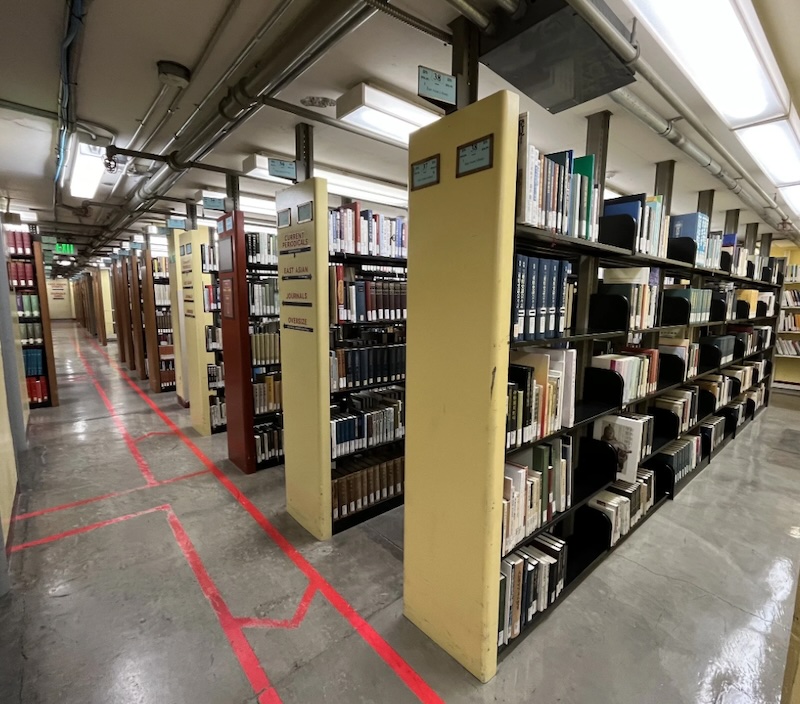
There are desks hidden throughout the 7 floors of book stacks!
Category Three: Miscellaneous
Many students don’t realize that when classes aren’t in session, you can use empty classrooms to get some work done. I especially like studying in the classrooms in Taper Hall and DMC. It’s a bit of a gamble, as you will get asked to leave if a class starts up, but it often works well in the afternoons or evenings when the buildings are quieter. There’s something nice about having a whole classroom to yourself to focus, spread out and bring a study group, or even practice a presentation.
The Tutor Campus Center (TCC) sits right in the heart of campus, next to the bookstore and the Tommy Trojan statue. The first floor is home to several popular lunch spots that accept dining dollars, as well as the Admissions Center. But the real hidden gem is upstairs — take the grand staircase (or the elevator) to the second floor, where you’ll find several student lounges. These spaces are sometimes reserved for events, but when they’re open, they make for a perfect mid-day study spot or a comfortable place to relax between classes.
Happy studying, Trojans! I wish you the best of luck!
⋯
Bridging Cultures, Building Futures: Our PP-MA Journey ⟩
October 2, 2025, by Global Initiatives Team
Beginnings and Endings Classes Community Diversity Getting Involved Housing and Transportation International Living in LA School/Life Balance What are OS/OT?
Hi everyone! We’re Angel and Haemin, international students in the 2025-2026 Post-Professional Master’s (PP-MA) program at USC. Coming from the Philippines and South Korea, we are starting this new chapter in Los Angeles! We’re excited to meet new people, explore new places, and grow together as OTs.
Angel’s Journey
My name is Angel, a pure-blooded Filipina and current PP-MA student for 2025–2026. I earned my OT degree in the Philippines and worked as a pediatric occupational therapist for three years — a role that brought me so much joy working with children and their families. In 2023, I got married, and by 2024 I had moved to the U.S. to be with my husband, first living in Chicago before deciding to continue my OT journey here in LA.


When I began exploring further studies, USC stood out immediately. Its Post-Professional MA is one of the few programs in the U.S. that can be completed in just one year, allowing internationally trained OTs like me to deepen our skills, discover new ideas, and connect with people from around the world — all while returning to practice sooner. I also heard wonderful feedback from colleagues who studied here, describing supportive faculty, a vibrant community, and an environment that pushes you to grow. Most of all, I was inspired by USC Chan’s mission to optimize people’s engagement in the ordinary and extraordinary activities of life — a statement that perfectly reflects why I chose OT in the first place.

Life in Los Angeles has been a big adjustment after Chicago and the Philippines — new city, new culture, and no familiar faces. At first, it was daunting, but having my husband’s support made the transition easier. Together, we’re slowly building our rhythm, exploring neighborhoods, and enjoying small routines that make LA feel like home. Lately, we’ve started visiting local cafés for matcha and coffee, and Little Tokyo has quickly become a go-to spot for food and culture.


So far, the PP-MA program has been both exciting and humbling. One of my favorite courses is Foundations in Occupational Science and Occupational Therapy, where we explore and challenge diverse perspectives on both OS and OT. Because our cohort includes students from many different countries, I have gained a deeper understanding of how culture and society influence a person’s occupations. I have also come to appreciate the importance of language in our work as occupational therapists when connecting with patients.

What I value most about this program is how it encourages us to think critically about OT while equipping us with practical tools to grow as clinicians and leaders. It’s not just about earning a degree — it’s about shaping how we want to contribute to the future of the profession.
Looking ahead, I see this year at USC as a stepping stone. My immediate goal is to gain licensure in the U.S. so I can continue serving people in healthcare. Beyond that, I hope to bridge what I learn here with my roots in the Philippines, finding ways to give back and strengthen OT globally.
Haemin’s Journey
My name is Haemin, and, like Angel, I’m a PP-MA student, class of 2026. I graduated from my home university in South Korea this year and moved to LA to attend USC Chan’s Master’s program. Being a PP-MA OT student at USC has been one of the most exciting chapters in my life. When I arrived in LA to start my journey, I had mixed feelings of both excitement and being overwhelmed. I moved into a new apartment, met new people and classmates, and tried to make a new daily routine. Even though there were a lot of things to take in on my own, I found myself becoming more independent and confident.
Back in 2022, I joined the Summer Occupational Therapy Immersion (SOTI) program as an exchange student. It was such a memorable time to interact with people from all over the world with warm and supportive instructors. I loved exploring various OT fields through guest lectures and field trips, and it made me want to reflect more on the kind of OT I’d like to become. These experiences inspired me to deepen and broaden my own view of occupational therapy and to find the areas of practice that truly align with my interests and passions. Finding that USC provides strong support and resources to help international students achieve these goals gave me the confidence to come here for my master’s program.
Even though I have experience of living in the US before, moving to LA for graduate school was still a new adventure. I set up a new apartment and established daily routines like meal prep, errands, and transportation to balance my work and studies. It took time to adapt to a new environment, but I was able to figure it out thanks to so much support from my family, friends, and professors at USC Chan. As I figure out step by step, I find myself having done so many things, which makes me feel confident and mature. 😊

One of the best parts of the PP-MA program is having classmates from all over the world. We share our OT experiences and cultures from our home countries, which makes every discussion richer and exciting. The atmosphere is so friendly and supportive, and the Global Initiatives team always makes me and other international students feel welcomed and connected. Working as a GI team member, I’m supporting students who want to celebrate their meaningful holidays, which is especially valuable in that I can learn about important cultural meanings from my classmates.
As for classes, Foundations of Occupational Science & Occupational Therapy has been my favorite! At first, OS felt a bit philosophical and abstract, but it helped me see what occupation truly means and what the OT’s role is from a global perspective. Having discussions with international classmates adds so much fun and depth. 😊
Even though we may have grown up in different countries and started OT in different ways, the PP-MA program at USC has brought us together. We’re learning, growing, and cheering each other on as we chase our own unique dreams as future OTs.


Outside the classroom, I love spending time at Hoose Library, which has a Harry Potter vibe. It’s so aesthetic and makes me focus on studying better.

Preparing for what’s next, one of my biggest goals during this program is earning the Sensory Integration (SI) certificate, which will be valuable for working with children. After graduation, I hope to continue working in pediatrics, especially with children and adults with ASD, and to expand into community-based practice. I’m excited to face my future clients with a richer perspective on occupation by everything I learned and grew from my time at USC.
⋯

Grad School in LA . . . WITHOUT A CAR?!?! ⟩
September 19, 2025, by Trinity
Fieldwork Living in LA
Hello all!
New fieldwork assignments are about to begin, and with that in mind, I wanted to write about navigating the program without a car.
One thing about me is that I HATE driving, especially in Los Angeles. Beyond the actual driving part, paying for parking, finding an affordable gas station, and dealing with car insurance are extra stressors that I have chosen not to take on for the four years I have lived here.
Being able to make this choice is an incredible privilege! While the public transit in Los Angeles does have a bit of a negative reputation, I know I am lucky that this is even an option for me since a car is essential in most American cities. That being said, it does take flexibility, time management, and willingness to make things work to rely on this option for everything.
Here in Los Angeles, most of the public transit does connect to major attractions. For example, I can take the light rail right to famous museums, restaurants, and Union Station. The light rail as well as the Metro buses are covered by USC’s UPASS program, so students can ride for free. Students also get a discount on Metrolink tickets, which connects all of southern California.
Because I have been here for four years, I have gotten fairly used to public transportation and USC shuttles as my main means of getting around. Since most of my life exists on a college campus, this has not been too bad.
However, the fieldwork component of the occupational therapy program has made relying on public transit a bit more challenging (but not impossible). Fieldwork placements can be anywhere within the vicinity of USC, which can mean up to a 2 hour commute away depending on where you stay. Most people get placements that are near their homes, which makes it a better commute.
Still, most people have cars in the program because of the commute and the potential distance to the fieldwork sites. I have gotten really lucky, and I still have not had to bring a car for fieldwork or any other obligations I have here. This is because of my willingness to put location of site as my number one priority as I make my fieldwork wishlists, as well as the generosity of my friends in the program.
My first fieldwork location was a mental health site in Long Beach, California. I was going to take the train, but my lovely fieldwork partner, Angela, picked me up every week. I will be forever grateful that she helped me get to fieldwork, and I definitely owe her one for life! Carpooling is one option that has saved me from getting a car in the program.

Next, I had my pediatric fieldwork in a children’s mental and behavioral health clinic. This location was within walking distance, and I was able to get there with ease every week. It was a huge blessing. Of course, this is not very common. I am not sure anyone else ever had a site as close as mine was to me.
This semester I am doing my geriatrics fieldwork at an assisted living facility in Sierra Madre. I will be taking a combination of public transportation options to get there. I was paired with one of my good friends, Joseph, in the program for this rotation, and we are going to take public transit together.

I still know several other people in the program who do not have cars, so it is definitely possible! There, of course, are elements of compromise. Sometimes, you won’t get your first choice of a site or it may take a while to get there. For me though, it is worth it financially and emotionally to not have a car. This might change with my next rotation, but I am so grateful this has been an option for me thus far. My biggest piece of advice is to make the most out of every fieldwork experience, even if it was not your first choice or if the commute is long. There is always something to learn at every place. Truly, I have been so incredibly lucky in this program!
TLDR: While it can present challenges, it is absolutely possible not to have a car in the program, especially if you are willing to be flexible and lean on others for support.
⋯
Social
Facebook Instagram LinkedIn TikTok YouTube