



Student Blog

Autism in the Community ⟩
February 13, 2017, by Kimmy
Classes Community What are OS/OT?
As prior blog posts have mentioned, the final semester of the program is full of unique electives. These classes range from lecture-based courses in advanced practice areas to research involvement to hands-on experiential opportunities. After reading over all of the course descriptions, I was most excited about this last category, which includes a class called Autism in the Community.
Despite keeping an open mind throughout the program, I have always wanted to work in pediatrics. I initially became interested in occupational therapy after learning about the role in schools helping children with developmental disabilities. Growing up, I used to visit the special education classroom during lunch to play games with the students in the class. It was a great way to relax during the day and become friends with new people!
Now, as I finish up my Master’s degree, I have found myself coming full circle. This past Friday, I visited a nonpublic school for children on the autism spectrum and spent two hours bonding with them over board games. To be clear, I played Connect 4 for graduate course credit — living the dream! Seriously, I had so much fun meeting this class of amazing students. Now that we have met the students, my classmates and I will each be assigned our own buddy from the special education classroom. In the coming weeks, we will take weekly field trips with our buddies to the California Science Center. Not only do these trips allow our buddies to learn and apply their science curriculum, but being in the community provides valuable opportunities to practice social skills and regulation. Reciprocally, my classmates and I gain hands-on experience working with adolescents with autism — in pretty much the most fun way possible. 😊
⋯
Choosing Your Area of Practice ⟩
February 10, 2017, by Erwin
Many students come into the program expecting to practice in a specific area. And if you’re like 90% of most prospective occupational therapy students, it’d be a safe guess that you want to work in pediatrics. That was definitely me when I was applying to occupational therapy schools. I was so gung-ho about working with children; I did all my volunteer hours in a pediatric clinic and also worked with children with special needs. I was all-in on working with pediatrics . . . that is until I went to USC.
A misconception that some students have is that the program will train you to be an occupational therapists in a specific area of interest. However, that is not the case. USC, and all other occupational therapy programs, train you as a generalist. Thus, when you graduate, you are qualified to work in any area of occupational therapy. Here at USC, we have 3 practice immersions to assist students in developing mastery over the various domains of OT. Those immersions are adult rehabilitation, mental health, and pediatrics. It’s awesome because you get exposed to other areas of occupational therapy that you would have never thought you’d be interested in. In fact, the majority of students actually come into the program wanting to practice in one area, and end up loving something else by graduation!
While I thought I wanted to work in pediatrics when I started the program, today, I’m torn between adult rehabilitation and working in adolescent mental health. I enjoy the pace and the work that is done in physical rehabilitation, but I also enjoy the connections I made with clients during my fieldwork in adolescent mental health. It’s funny because I was so intimidated of both areas before entering the program, but now I can’t see myself doing anything else! Occupational therapy is such a wonderful and diverse profession that sometimes it’s hard to choose one area to work in. But on the flip-side, if you ever feel tired of working in one area, you can always mix it up and enter another area of practice!
⋯
Excellent Externship Experience! ⟩
February 8, 2017, by Kimmy
As part of OT 540: Leadership Capstone, one of the final required courses of the Master’s program, all students embark on a two-week long externship experience. During this course, students learn about the many skills that contribute to being a leader. Various facets of leadership include developing strong personality traits, collaborating on interdisciplinary teams, joining professional organizations, and understanding a profession’s role within a wider job market. In California, occupational therapy is represented by the state organization Occupational Therapy Association of California, as well as at the national level with the American Occupational Therapy Association, both of which advocate on behalf of occupational therapists by protecting the scope of practice, supporting research, and publicizing the profession.
In addition to weekly questionnaires and a public policy discussions, the main project of the class is centered on the Leadership Externship. Different from an internship, an externship is a short-term immersion in a new experience. Externships emphasize active observation, in which exposure to new opportunities leads to the development of new ideas.
One of the greatest features of this assignment is that it is student-driven, meaning it is up to you where you want to go, what you want to learn, and how you will learn it! Students develop their own learning objectives and shape the externship process around meeting them. Because the class is focused on leadership, the ultimate goal is to learn about management, advocacy, and professionalism.
One of the other greatest features of this assignment is that the externship dates are scheduled right before Spring Break, giving students the opportunity to travel for an additional third week. The combination of student-driven work and three weeks off from classes allows many students to complete externships out-of-state — or even internationally! Global Initiatives, the department within the Chan Division focused on international connections, organizes multiple Student Exchange Programs. Through these programs, students complete the externship at partnered universities to observe occupational therapy programs at different universities and experience the field of occupational therapy in a different country!
In just over two weeks, I will embark on my externship to Griffith University in Australia, so stay tuned for travel updates. 😊
⋯
Financing USC: Scholarships Edition ⟩
February 7, 2017, by Jessica
In continuing with my “Financing USC” series, this week’s post is all about scholarships. Students are always interested about what scholarship options are available, and the likelihood of getting one. Hopefully this brief post can help answer some of those questions!
There are scholarships available to students from the OT division based on academic merit and potential for special contributions to the field of OT. The most common are the Division Tuition Scholarships, which are awarded on the basis of academic achievement, mainly for first-year entry-level Master’s students. The amount of the scholarship varies each year and between students, and goes directly to help pay for your tuition. A highly competitive scholarship through the OT division is the Research Assistantship, which is awarded based on academic merit primarily to first-year entry-level Master’s students. For this scholarship, generally 8 units of tuition are covered per semester, with a $5500 stipend per semester, with student health services and student health insurance included. Keep in mind, though, that these are really hard to get! Another unique option is to become a Division Student Worker! These are considered division awards, and students chosen for these positions will fulfill varies duties for faculty and staff members. Typically, only 2nd years receive these positions. Some of the jobs you could have in the division are being a classroom assistant, a fieldwork assistant or office assistant, and being a student ambassador (like us!). Students in these positions get paid hourly for their work, and have a flexible schedule of about 10 hours per week. If you’re interested in any of the division scholarships, be sure submit the scholarship application at the same time you submit your application for the program.
There are many other unique scholarship options through the division, as well as outside of USC, which are listed on our website. Check that out and see if you’re eligible to apply for any of those scholarships!
⋯
Why USC? ⟩
February 6, 2017, by Erwin
Why should I attend USC? Many prospective students ask this question looking for a convincing sales-pitch. However, my job isn’t to sell people on USC, but rather, let them know the opportunities available here. USC is a wonderful school and we have an amazing program. However, it may not be the right fit for everyone. With that being said, here are a few reasons why I think USC OT stands out from the crowd:
- Networking
The Trojan Family is a powerful thing. Because of USC’s status in OT, and really the world, I wanted to be well-connected and part of that Trojan network. Being at USC has opened doors for me that I’m not sure would have been possible if I had went to another university. - Leadership
I strongly feel that what makes USC unique to other programs is its commitment to leadership. USC is known to be a leader for the profession of occupational therapy and the school encourages students to become leaders themselves. At USC, there are tons of opportunities for students to get involved — whether through student organizations or support from faculty to pursue your own leadership interests. Being at USC, I’ve grown so much as a leader and I know the skills I’ve learned here will benefit me throughout my career. - Research
USC is also known for its research contributions. Occupational science, the science that serves as the foundation for occupational therapy, was invented here at USC and we continue to be at the forefront of research. Some of the most exciting and groundbreaking research is being done in our division and students have the opportunity to be research assistants. When I entered the program, I didn’t have much interest in research, but it really is so important to validate what we do as therapists and to discover more effective treatments so that our clients can receive the best care. - Faculty
USC’s faculty consists of some of the best therapists and researchers in the world. Being leaders in occupational therapy, many of our faculty are the ones writing our textbooks so they can answer any questions you may have. In addition, they are so supportive and almost all have an open-door policy so that you can discuss anything from school to life.
Ultimately, it is up to you to decide if USC is the right fit for you. Everyone has their own priorities and path to become an occupational therapist. For myself, going to USC was absolutely the best decision.
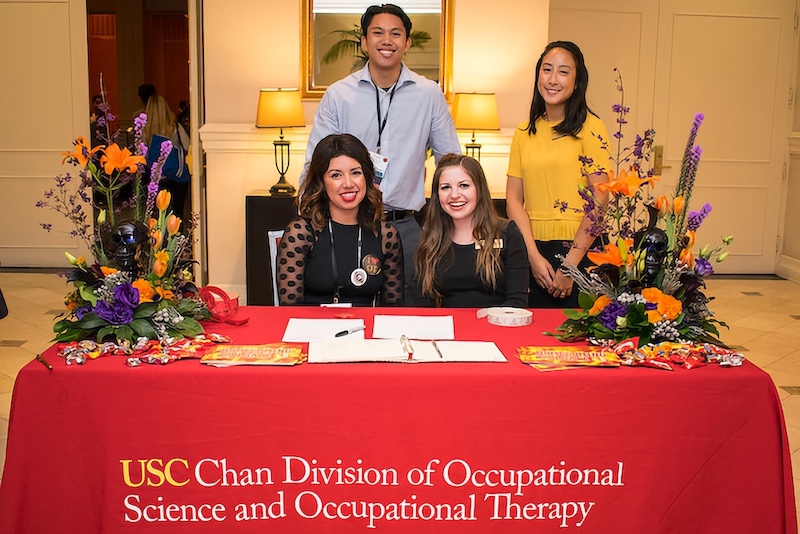
Me with the other student ambassadors!
⋯
Social
Facebook Instagram LinkedIn TikTok YouTube