




Student Blog
Videos

Winter Break Occupations ⟩
January 11, 2021, by Yna
Diversity International Videos
Happy 2021 everyone! I hope you all had a wonderful time during the holiday season and are feeling well-rested and ready to start this year anew. We are but a few days away from going back to school for the spring semester. Despite being in this extraordinary circumstance, it’s delightful to witness people finding unique ways to celebrate the season. I can say at least for myself that the break has been restful and rejuvenating, for I’ve had plenty of opportunities to catch up with closest family members as we stayed in and simply spent time with each other.
As all things must come to an end, it is now time to face reality—going back to school! I find it quite difficult to believe that this will already be my final semester before graduating. I know that once we step into the new term, we’re going to be too busy to even take note of the amount of time passing by — at least this was my experience during the last semester. But however daunting this may seem, it is also exciting to think about all the new experiences and learnings that I will be gaining with my amazing classmates and supportive professors as we all go through this common yet unique journey together. I try to remind myself to just enjoy the ride and keep in mind that everything’s going to be alright. Now, it’s time to turn any worry into productive preparation for all the exciting things in store for us this year!
⋯
Life as a Student Worker ⟩
November 2, 2020, by Yna
Classes Getting Involved Videos
“Is it possible to work while studying?” This is one question that frequently comes up and understandably so, given the full-time enrollment and the intensive nature of the academic programs at USC Chan. The answer to this question is yes, it is a possibility for one to work while studying. Although it really depends a lot on the individual, I would say roughly about 10-12 hours per week is recommended. To give you a better idea on how this is dispersed throughout the week, I am going to share with you my typical work-study schedule and some of my duties as a student ambassador.
As a Post-Professional Master’s student, I am currently taking a total of 18 units for this fall semester, comprised of 3 core courses (8 units) and 3 elective courses (10 units). For a better visualization, here’s a table showing how my weekly class schedule looks like.
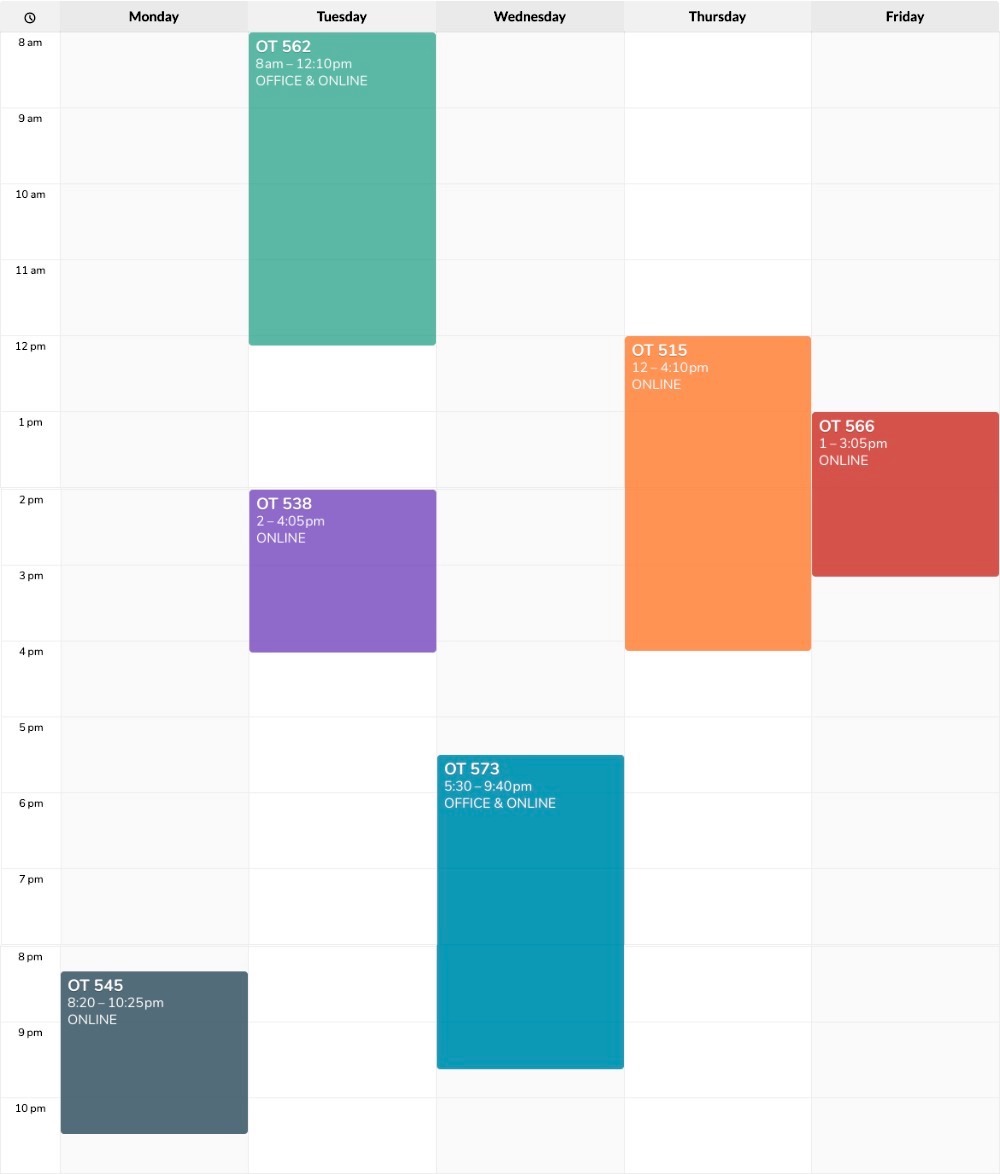
Class schedule for the fall semester
As you can see, you really only spend a few hours of your day sitting in class. However, do note that for each course, there are out-of-class activities and requirements that need to be worked on, which could take up a substantial portion of your time.
I schedule my work hours as a student ambassador around my class schedule, so I typically work on Mondays, Wednesdays, and Fridays in the morning before my class, totaling to 10 hours per week. One thing that I really like about being a student worker at USC Chan is the flexibility in scheduling that they give students that allow us to move our time around in case we have exams or other requirements to prepare for. This is also made possible by the amazing team of student ambassadors who are always willing to help out whenever one of us is having trouble fulfilling our duties. Our supervisor, Kim, never fails to remind us on every team meeting to prioritize our academics and also take care of our health.
One of my tasks as a student ambassador is to liaise with Global Initiatives for certain projects. This is another area where I find the flexibility in scheduling really helpful, especially for time-sensitive projects, because you can choose to dedicate most of your work time to accomplishing it or even work on the weekend if you’re willing to. For example, for the recent World OT Day last October 27, we created a video that shows how people all over the world have reimagined their doings. Check it out below!
Sometimes, I also give informational presentations together with the admissions team, as part of our role to help raise awareness about occupational therapy and our programs at USC. Other ways we can disseminate information and share our experiences as current students and student workers is by posting to Chan Division social media accounts (check us out on Facebook, Instagram, and YouTube!), writing blog posts about our experiences, and answering questions from prospective students. Lastly, student ambassadors also partake in certain steps of the admissions process, with the guidance of our Director of Admissions, Dr. Anvarizadeh.
Hopefully this glance into my life as a student ambassador answers some questions you may have about being a student worker! If you have any questions, you can reach the ambassadors at .(JavaScript must be enabled to view this email address).
⋯
Back To OT School Day ⟩
October 19, 2020, by Calvin
Classes Videos
I hadn’t been back to school since like . . . March, which was around the time when we were all informed that courses were going to be moved online due to the pandemic. Ever since then, I’ve missed being with everyone in person, and I also kind of missed sitting in the classroom and being in that learning space. I’m so thankful that the division is allowing students to go back to class on some days because honestly, there are just some things that are learned better in person!
At first, I was pretty hesitant about going back because of the potential risk, but so far it’s been working out great! We’ve learned to be more flexible in order to adapt to this new learning format, and it feels good to see everyone again. Here’s a video on what my first day back to school looked like!
⋯
My first time on campus ⟩
October 2, 2020, by Yna
Classes Videos
From the time I enrolled in my Master’s program at USC, one thing I had really been looking forward to was getting to visit the beautiful campus that I have only been seeing in pictures. Unfortunately, due to the pandemic and in efforts to socially distance, I have not been able to do this since most of our classes had to be held remotely. One of the courses I was enrolled in, however, entailed an on-campus lab class which gave me the opportunity to finally visit the campus for the first time!
If you’d like to see my experiences during my first time on campus and are curious about the safety protocols in place to keep the Trojan community safe and healthy, check out my video below!
[Credits to Elmo Nicolas for some of the video clips]
⋯
Humans of USC Chan Volume 1 ⟩
September 21, 2020, by Calvin
Classes Diversity Videos What are OS/OT?
When I was applying to OT school, I remember that I really wanted to get different student perspectives on what programs were like and how they navigated graduate school. As a student ambassador, I feel so lucky to have the opportunity to share my experiences with all of you, but I know that there are so many other extraordinary voices in the division too!
So, I gathered some second-year Entry-Level Master’s students to come and talk about what their OT school experiences have been like so far! We went over topics related to what kind of OT they’re interested in, what their favorite classes and memories are, and what challenges they’ve faced. They even shared some advice for all of you thinking about applying to the program! If you watch it through YouTube, the video is time-stamped with each topic in case you ever want to go back to a specific conversation.
I hope you find this video helpful and that these diverse perspectives give you more insight into what student life is like in the Master’s program! Welcome to the Humans of USC Chan!
⋯
Social
Facebook Instagram LinkedIn TikTok YouTube